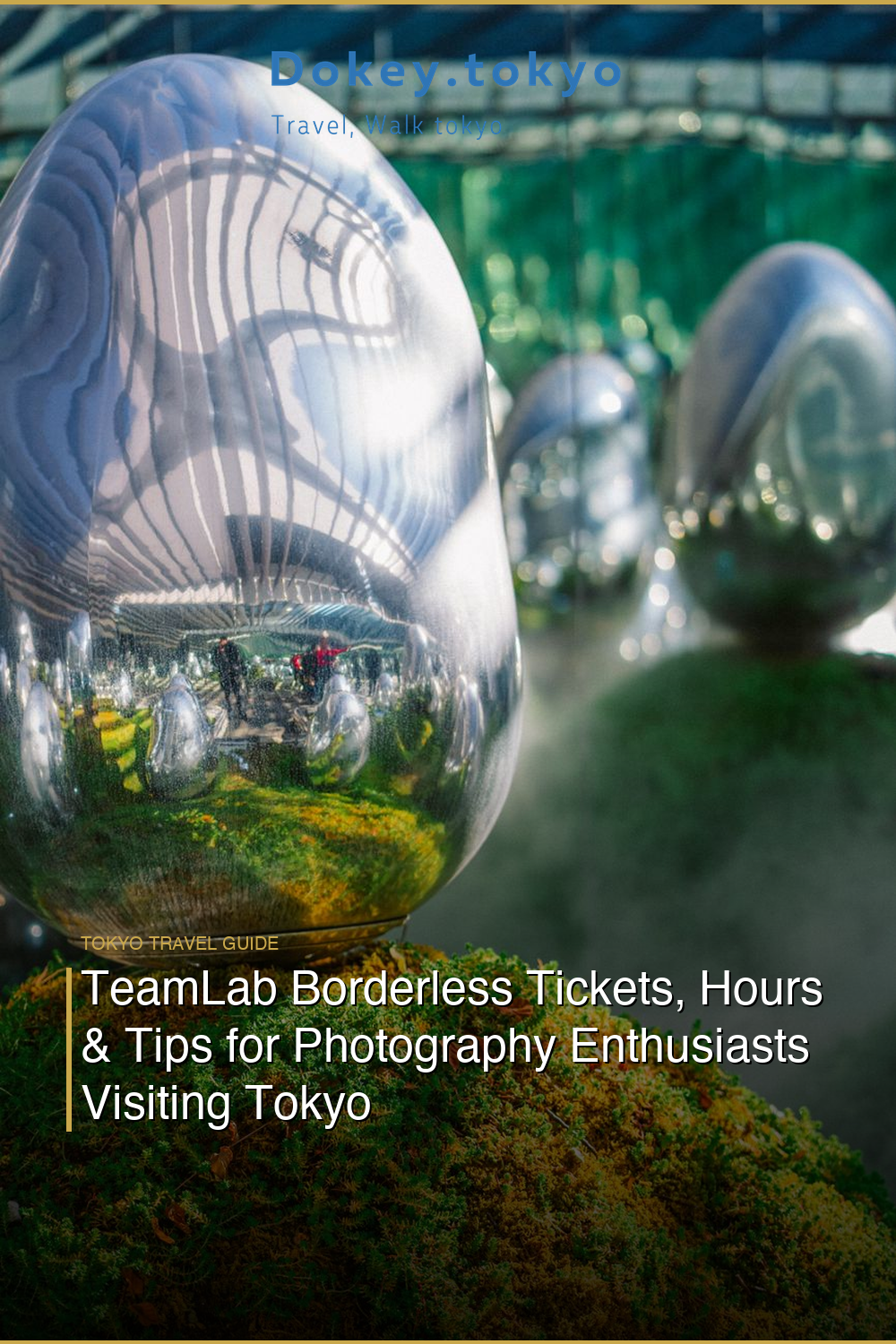
If you’ve spent any time scrolling through travel photography feeds and wondered where those dreamlike images of people dissolving into infinite waterfalls of light actually come from — it’s here. TeamLab Borderless in Tokyo is not just a museum; it’s a living, breathing canvas that moves around you, responds to your presence, and refuses to look the same twice. For photographers, it is genuinely one of the most extraordinary indoor shooting environments on the planet, and I say that after visiting five times across different seasons and different locations of the venue.
The first time I walked through the entrance tunnel at the original Odaiba location, the sound hit me before the light did — a low, resonant hum layered with something that felt like wind chimes being played underwater. Then the darkness gave way to color, and I stood there for a full thirty seconds with my camera hanging at my side, completely forgetting why I’d come. The air smelled faintly of something clean and electric, like the moment before a thunderstorm, and my eyes genuinely couldn’t decide where to look first.
What Is TeamLab Borderless and Why Photographers Go Obsessed
🎫 Book on Klook: TeamLab digital art museum →
TeamLab Borderless is a digital art collective’s magnum opus — an entire building where artworks are not contained in frames or rooms but spill into each other, bleed across floors and ceilings, and interact with every visitor who walks through. Unlike TeamLab Planets (the other Tokyo venue, which is more structured and walkable), Borderless is intentionally maze-like. You wander. You get lost. You stumble into a room you’ve never seen before even on your third visit.
For photographers, this architecture is a gift. Every corner offers a new composition. The light is constantly shifting. And because the art literally moves and changes, no two frames are identical — which means the pressure to “get the shot” is replaced by the joy of discovering what shows up on your screen.
The New Location: Azabudai Hills
After closing its iconic Odaiba space in 2024, TeamLab Borderless reopened in February 2024 at Azabudai Hills in Minato Ward — a brand new complex that’s easier to reach and significantly more polished in its design. The new address is 9-7-4 Higashi-Azabu, Minato-ku, Tokyo. It’s a 5-minute walk from Roppongi-Itchome Station on the Namboku Line, or about 10 minutes from Roppongi Station on the Hibiya or Oedo lines.
The new space is larger, with higher ceilings in key rooms — which, if you shoot wide-angle, means you can finally capture those soaring vertical compositions without clipping the top of the light columns.
TeamLab Borderless Tickets: Everything You Need to Know
Ticket Prices (as of 2024–2025)
Adult tickets (18 and over) are priced at ¥3,800 on weekdays and ¥4,200 on weekends and public holidays. Teenagers (13–17) pay ¥2,000, children (4–12) pay ¥1,000, and kids under 3 enter free. There are no photography add-ons or tripod fees — though more on gear restrictions in a moment.
Important for budget planning: TeamLab Borderless does not sell tickets at the door. Every single ticket must be purchased online in advance through the official TeamLab website (teamlab.art) or through authorized resellers. This is non-negotiable. I’ve seen photographers show up with their full kit, no advance booking, and be turned away — devastating when you’ve carried a mirrorless body and three lenses across Tokyo.
How to Book Smart as a Photographer
Book directly at teamlab.art for the most flexibility. You choose a date and entry time slot (usually in 1-hour windows), but once inside, you can stay as long as you want — there is no exit time. For photographers, I strongly recommend booking the first entry slot of the day, which on most days opens at 10:00 AM. The crowds are thinner, the light in the outdoor-adjacent spaces is softer, and you’ll have wide compositions to yourself for at least the first 20–30 minutes before the tour groups arrive.
TeamLab Borderless opening hours are generally 10:00 AM to 8:00 PM on most days, with last entry at 7:00 PM. On certain Fridays, Saturdays, and holiday periods, hours extend to 9:00 PM. Always verify on the official website before your trip since hours shift seasonally and around Japanese national holidays.
What to Shoot: The Must-Visit Rooms for Photographers
The Forest of Resonating Lamps
This is the room that breaks photographers. Hundreds of glass orb lanterns hang at varying heights, shifting through the full color spectrum in response to sound and motion. When another visitor approaches a lamp, it blooms into white light and sends a ripple of color through every surrounding orb. Shoot this at a slow shutter speed — I typically use 1/15s at f/2.8, ISO 800 — and let the motion of the light trails do the compositional work for you. Position a person in the foreground and let the color wash blow out softly behind them.
Borderless World
This is the signature space where multiple artworks merge and flow across every surface. Koi fish become flowers become petals become light. On my third visit, I crouched low against one wall for nearly forty minutes, shooting from a ground-level angle that made visitors look like they were floating inside a galaxy. A Japanese university student noticed what I was doing, laughed, and said “nani sore” — “what even is that?” — when she saw my screen. She was right to be amazed.
The Athletics Forest
Less photographed but wildly underrated — a bouncy, interactive space filled with hanging light ribbons that respond to touch. The motion blur potential here is extraordinary, especially if you’re shooting at dusk when the ambient light outside has dropped and the internal glow becomes the dominant source.
Practical Photography Tips for TeamLab Borderless
Gear and Restrictions
Handheld cameras and mirrorless systems are fully permitted. Tripods and monopods are not allowed inside — this is a firm rule enforced by staff. This means you’re relying on image stabilization, wide apertures, and high ISO performance. A fast 24mm or 35mm prime lens is your best friend here. If you shoot Sony, Canon R-series, or Nikon Z-series, the in-body stabilization will carry you.
Flash photography is prohibited throughout the entire venue — and honestly, flash would ruin everything anyway. The entire experience is about the light that’s already there.
Bring a lens cloth. The humidity inside some rooms, particularly those with mist effects, will coat your front element within minutes.
Clothing and Composition
Wear something that interacts with the light. White, cream, and pale lavender clothing picks up the color projections beautifully and makes you or your subjects glow from within. Avoid black entirely — it absorbs the light and flattens the effect. This sounds like a fashion tip, but it is genuinely one of the biggest differences between flat snapshots and images that feel transported.
Timing Your Visit
For the absolute best shooting conditions, arrive at opening (10:00 AM) on a Tuesday or Wednesday — statistically the least crowded days. Avoid the first two weeks of Golden Week (late April to early May) and the Obon period in mid-August unless you want to practice your patience and your elbow technique. Winter weekday mornings in January and February are when I’ve consistently had the most space and the most creative freedom.
Food and the Surrounding Area
Azabudai Hills, the complex where Borderless now lives, is genuinely beautiful and filled with excellent food options. After a long shooting session, I wandered into a small udon counter on the B1 level of the Hills Tower and ordered a cold kakiage udon — crispy tempura vegetable cake on top of hand-cut noodles in a dashi broth so clean it tasted like the sea had been distilled into a bowl. I sat at the counter, scrolled through my frames with one hand, and ate with the other, and the afternoon felt quietly perfect in the way only solo travel days can.
For coffee before your visit, Azabudai Hills has a Blue Bottle outpost that opens at 8:00 AM — ideal for a pre-opening caffeine ritual while you review your shot list.
Final Thoughts Before You Book
TeamLab Borderless is the rare place that delivers more than the photos suggest — and the photos already suggest everything. For photographers, it’s not just an attraction; it’s a workshop in light, motion, long exposure, and finding composition in pure chaos. The new Azabudai Hills location has elevated the experience with better infrastructure, more space, and a surrounding neighborhood that rewards the kind of slow, curious wandering that good travel photography requires.
Book your tickets early, go on a weekday morning, pack a fast prime lens, and wear something that glows. Then put the camera down for at least ten minutes and just stand inside the light. It changes you a little, and the best photographs always come after that.