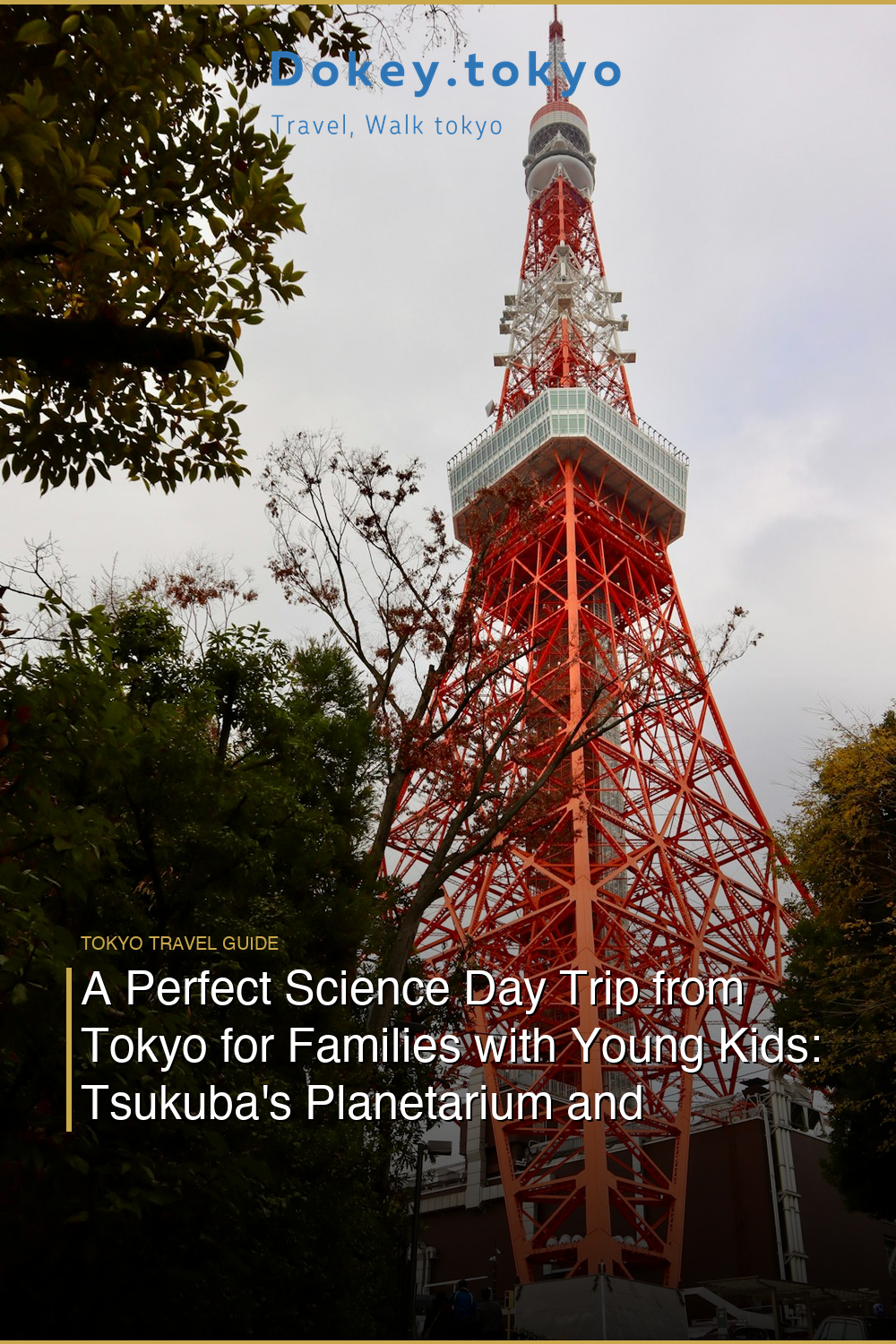
If you’ve already done Disneyland Tokyo twice and your kids are starting to side-eye another temple visit, I need to tell you about Tsukuba. Specifically, the National Museum of Nature and Science’s sister institution energy in this science city, and most importantly — the Tsukuba Expo Center, home to one of Japan’s most jaw-dropping planetariums and a building full of interactive science exhibits designed to make children genuinely lose their minds with excitement. This is the kind of day trip where you arrive back at your Tokyo hotel with tired, happy kids who won’t stop talking about how big the universe is. And honestly? You’ll feel exactly the same way.
I still remember stepping off the Tsukuba Express at Tsukuba Station for the first time on a crisp October morning, my daughter’s hand in mine, the air noticeably cleaner and quieter than anything we’d experienced in Shinjuku all week. The station itself smells faintly of cedar from nearby shops, and there’s this particular stillness — no train horns screaming, no crushing crowds — just a wide, planned city boulevard stretching ahead of us like a science fiction set. My daughter looked up and said, “Mama, is this space?” She wasn’t entirely wrong.
Why Tsukuba Is a Dream Day Trip for Families
Tsukuba is only about 45 minutes from Akihabara Station on the Tsukuba Express, which means you’re not dealing with a grueling journey before you’ve even started. For families with small children, that commute length is the sweet spot — short enough that even a restless three-year-old can manage it without a full meltdown, long enough that it genuinely feels like an adventure. The city itself was purpose-built as Japan’s science capital in the 1970s, which means it’s unusually green, walkable, and organized. There are wide pavements, gentle slopes, and almost no aggressive traffic near the main attractions. For parents pushing strollers or managing a toddler who insists on walking independently at the pace of a sleepy turtle, this is a genuinely rare gift.
The Tsukuba Expo Center: Your Main Event
🗾 Book on Viator: Multi-facility pass includes science mus →
The Planetarium That Will Change Your Child’s Life
Let me be direct: the planetarium at the Tsukuba Expo Center is not your average school trip dome show. It features a massive 25.6-meter dome — one of the largest in Japan — and a Medialis projector system that renders the night sky in extraordinary resolution. They run different shows throughout the day, including dedicated programs specifically designed for younger children that explain constellations and the solar system through gentle narration and animation rather than overwhelming scientific jargon.
I’d recommend booking seats for the first morning show the moment you arrive, before exploring the rest of the exhibits. The shows sell out faster than you’d expect, especially on weekends and during school holidays. The children’s program typically runs around 40 minutes — perfectly calibrated for little attention spans — and the moment the lights dim and the ceiling erupts into a field of stars, you will hear a collective gasp from every child in that room. My own kids grabbed my arms simultaneously. That sound — that audible wonder — is worth every yen of the journey.
Interactive Science Exhibits That Actually Engage Kids
The floors surrounding the planetarium are packed with hands-on science exhibits that go far beyond the “look but don’t touch” museum experience. There’s a working model of the H-II rocket (Japan’s flagship space launch vehicle) that towers over the main atrium — the real outdoor version stands outside the building and is almost comically massive when you’re standing next to it with a five-year-old. Inside, children can experiment with energy generation, explore earthquake simulation stations, and crawl through models demonstrating basic physics principles in ways that feel more like play than education.
One unexpected discovery that completely hijacked our schedule: tucked near the energy exhibit on the second floor, there’s a small wind tunnel station where kids can design little paper shapes and test how they fly. A museum staff member — a retired engineer named Kenji-san, who spoke just enough English to communicate the important bits — spent nearly twenty minutes with my son adjusting his paper wing designs and explaining in delighted, gesturing Japanese exactly why each shape flew differently. My son understood maybe thirty percent of the words and one hundred percent of the enthusiasm. We stayed at that station for almost an hour.
Food and Refueling: Keeping Small People Happy
One of the smartest things you can do as a parent at Tsukuba Expo Center is plan your food break strategically. The museum has a small café on-site that serves reliable, kid-friendly options: curry rice, hot dogs, simple pasta dishes, and the obligatory soft-serve ice cream that Japanese children seem to locate by some kind of magnetic sense. The curry rice is genuinely good — mild, slightly sweet, the kind that doesn’t require any negotiation with a picky eater.
If you want a sit-down meal, the shopping and dining area around Tsukuba Station (a short bus ride or fifteen-minute walk away) has a Tsukuba staple: ramen restaurants and family teishoku (set meal) spots where kids get smaller portions and nobody stares at you for taking forty-five minutes to eat because your toddler is rearranging their rice into geometric patterns. I specifically loved a small tonkotsu ramen shop near the station where they handed my daughter a tiny bowl of plain noodles with butter without being asked. That unsolicited kindness is peak Tsukuba.
Practical Tips for Families
Getting There
- Take the Tsukuba Express (TX line) from Akihabara Station. Rapid trains reach Tsukuba Station in approximately 45 minutes.
- IC cards (Suica or Pasmo) work seamlessly on this line — no need to buy separate tickets.
- From Tsukuba Station, take the Kantotetsu bus toward Expo Center (about 10 minutes) or walk the 2km route, which is pleasant but might be too long with very young children.
Tickets and Timing
- Expo Center admission is very affordable — roughly ¥500–¥800 for adults and free or reduced for children under elementary school age.
- Planetarium shows cost extra (approximately ¥400–¥600 per person) and require separate tickets purchased at the venue.
- Arrive when the museum opens at 9:30 AM to secure planetarium show tickets before they’re gone.
- Avoid national holidays and the weeks of Golden Week (late April–early May) and Obon (mid-August) — these are peak domestic family travel times and queues at the planetarium can become very long.
Best Time to Visit
- October and November are my personal favorites: the weather is cool and comfortable, the crowds are thinner, and the clear autumn skies make the short walk around the Expo Center grounds genuinely beautiful.
- Weekday visits are dramatically more relaxed than weekends — if you can swing a Thursday or Friday, the interactive exhibits won’t have queue times at all.
Stroller and Accessibility Notes
The Expo Center is fully stroller-accessible with elevators between floors. Baby changing facilities are available in both the men’s and women’s restrooms — a detail that feels small but matters enormously at 2 PM when you’re already tired.
One Moment I Keep Coming Back To
At the end of our last visit, just before the final planetarium show of the evening, I sat on a bench outside with my younger daughter while my husband took my son to the gift shop. The outdoor H-II rocket was lit up against a darkening sky, and she was eating the last of her soft-serve, methodically, with tremendous concentration. She looked up at the rocket, then up at the first stars appearing overhead, then back at her ice cream. “The stars are ice cream scoops,” she announced with absolute authority. I don’t know if any scientist at Tsukuba University has ever proposed that theory, but standing there in the cooling October air, watching her make that connection between what she’d learned inside that dome and the actual sky above her head — that is the whole reason you take children to places like this.
Final Thoughts: Is It Worth the Day Trip?
If you’re traveling Tokyo with kids aged roughly three to ten, a Tsukuba Expo Center day trip belongs on your itinerary above almost everything else. It’s affordable, accessible, genuinely educational without being dull, and it gives children the kind of immersive, sensory-rich experience that stays with them long after they’ve forgotten which temple they visited on day four. You’ll leave with tired legs, an inexplicable desire to learn more about black holes, and children who will ask you for the next week whether you can see Saturn from your bedroom window. The answer, if you’re lucky and the sky is clear, is sometimes yes.
Ready to experience it?
🗾 Book on Viator: Interactive exhibits for all ages →