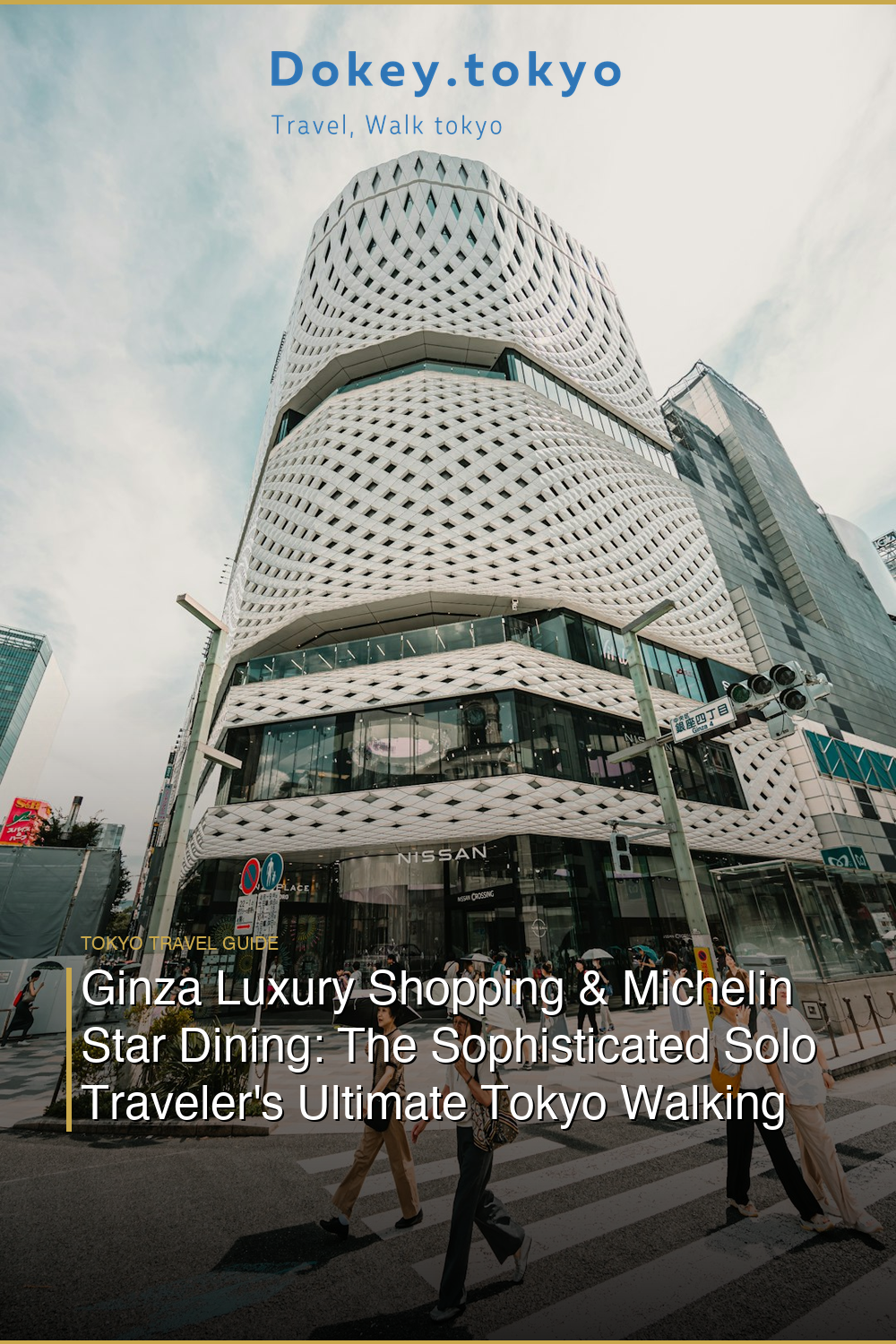
There is a particular kind of magic that happens when you step out of Ginza Station on a crisp October morning and realize that you — just you, your good coat, and your appetite for the extraordinary — are about to spend an entire day in one of the most sophisticated square kilometers on Earth. Ginza is not Tokyo’s loudest neighborhood. It doesn’t pulse with the neon chaos of Shinjuku or hum with the youth energy of Harajuku. Instead, it breathes. Slowly, deliberately, luxuriously. And as a solo woman who travels specifically to feel the full weight of a new place without anyone else’s itinerary getting in the way, I can tell you that Ginza rewards exactly that kind of focused, unhurried attention.
I still remember the first time I arrived on Chuo-dori on a Sunday morning, when the boulevard is closed to traffic and becomes a pedestrian promenade. The air smelled faintly of fresh flowers spilling from a florist near the Mitsukoshi department store entrance, and the sound of distant piano music — someone practicing behind an open window several floors up — floated down between the glass facades. I stood still for a full minute, suitcase at my feet, just listening. That was the moment I understood that Ginza operates on a different frequency entirely.
Why Ginza Is a Solo Woman’s Luxury Playground
Let me be honest about something that guidebooks rarely say out loud: Ginza is an exceptionally safe and comfortable neighborhood for solo women. The streets are wide, well-lit, and patrolled discreetly. Staff in every establishment — from department stores to the smallest gallery — are attentive without being intrusive. You will never feel out of place dining alone at a high-end counter restaurant here because the omakase format was practically designed for the solo diner: you sit, the chef performs, you eat. It is the most intimate and yet completely solo-friendly fine dining experience in the world.
Ginza also has a culture of quiet elegance that aligns perfectly with solo travel. Nobody is rushing you. Nobody is staring. The neighborhood’s clientele is international, sophisticated, and accustomed to women who know exactly what they want.
The Luxury Shopping Route: How to Walk It Right
Start at Ginza Six — But Go Upstairs First
Most visitors head straight for the brand floors, but my strongest advice is to start your morning at Ginza Six’s rooftop garden on the 13th floor. It opens at 10 a.m., admission is free, and you will have the best elevated view of the district before the crowds arrive. Grab a coffee from the small café kiosk up there, take twenty minutes to orient yourself, and watch the city wake up below you. Then descend into the shopping floors with purpose.
Ginza Six stocks over 240 brands across its six floors, including the Japanese flagship stores of Céline, Dior, and Loewe, alongside exceptional Japanese designers like Issey Miyake and Fumito Ganryu. What makes this different from other luxury malls is the art installations — the atrium changes its suspended sculptures seasonally, and the basement level hosts a rotating gallery that is worth visiting even if you never open your wallet.
The Chuo-dori Flagship Walk
From Ginza Six, walk north along Chuo-dori and give yourself permission to be slow. This is the spine of Ginza luxury retail. You will pass the Hermès Maison Ginza — the glass brick building designed by Renzo Piano that glows like a lantern at night — and the Uniqlo flagship, which I include because their collaboration pieces with Japanese artists are genuinely collectible and make meaningful, packable souvenirs.
Don’t overlook Itoya, the legendary stationery store on Ginza’s back streets. Nine floors of the most exquisite paper goods, fountain pens, leather notebooks, and Japanese washi products you have ever seen. I once spent ninety minutes there and left with a hand-bound travel journal that I have used on every trip since. A staff member named Kenji spent fifteen minutes helping me understand the differences between three types of washi paper. He spoke quietly, handled each sheet with reverence, and when I finally chose one, he said simply, “This one has good memory.” I didn’t fully understand what he meant, but I believed him completely.
Dover Street Market Ginza
For the fashion-forward solo traveler, Dover Street Market’s Ginza outpost is essential. Seven floors of conceptual fashion presented like an art installation — Comme des Garçons, Sacai, Gucci collaborations, and emerging Japanese labels displayed with the kind of curatorial intelligence that makes shopping feel like a museum visit. The top-floor Rose Bakery café is an excellent lunch stop: their seasonal grain salads are fresh, light, and won’t leave you sluggish for the afternoon ahead.
Michelin Star Dining in Ginza: Eating Alone Has Never Felt This Right
🗾 Book on Viator: Ginza Izakaya Hopping Food Tour with Loc →
The Omakase Counter Experience
If you have never sat alone at a Japanese omakase counter, Ginza is the place to do it for the first time. The format — where the chef selects and prepares each course directly in front of you — turns a solo meal into a private performance. You are not dining alone; you are the audience.
Sushi Yoshitake (three Michelin stars) is among the most acclaimed sushi counters in Ginza. Reservations must be made months in advance through your hotel concierge or a reservation service like Tableall or Omakase. Lunch courses run significantly less than dinner and are a smarter entry point for first-timers — expect to pay around ¥25,000–¥35,000 for lunch. The nigiri here is served at precise body temperature, the rice seasoned with a red vinegar that gives it a faint blush color and a flavor complexity I have never encountered anywhere else.
Tempura Kondo (two Michelin stars) is another counter experience I recommend specifically to solo women because of its intimate eight-seat layout and the exceptional English communication from the staff. Chef Fumio Kondo is famous for his seasonal vegetable tempura — his lotus root and sweet potato preparations are studied meditations in restraint. I watched him fry a single burdock root slice for exactly thirty seconds one evening, plate it on handmade Arita porcelain, and tell me with a small smile, “This one is today’s best vegetable.” He was not wrong.
Pre-Dinner Drinks: Bar High Five
Hidden in the basement of a nondescript building near Ginza’s backstreets, Bar High Five is routinely listed among the world’s best bars. It seats only a dozen people, and the bartenders — led by the legendary Hidetsugu Ueno — will ask you a few quiet questions about your flavor preferences and then create something that feels like it was made specifically for your biography. I arrived jet-lagged on my third visit, told them I needed something that tasted like “starting over,” and received a yuzu and gin cocktail so perfectly balanced it made me laugh out loud at the bar. Solo travel, after all, is full of these private, unwitness-able moments of joy.
Practical Tips for the Solo Female Traveler in Ginza
Dress the part — but comfortably. Ginza has a dress code culture without a literal dress code. Smart casual is respected everywhere; you won’t be turned away in jeans, but you will feel more at ease and receive warmer service in a polished, put-together outfit. Comfortable shoes matter enormously — the marble floors of department stores are brutal after four hours.
Book dining reservations before you leave home. This is non-negotiable for Michelin-starred counters. Use your hotel concierge as your secret weapon — a call from a well-regarded Tokyo hotel carries significant weight with reservation desks that routinely turn away direct email requests.
Visit on a weekday if possible. Sunday pedestrian boulevard is magical, but Saturday and Sunday bring the crowds. Tuesday through Thursday mornings in Ginza feel like you have the neighborhood to yourself.
The Ginza Corridor for evening walks. After dinner, walk the covered shopping arcades east of Chuo-dori. The smaller galleries, jazz bars, and French-inflected wine bistros tucked into these side streets are where Ginza’s real personality lives after dark.
The Moment I Always Come Back To
On my fifth visit to Ginza, I ended a long day at a tiny counter wine bar on a back street near Shimbashi — eight seats, a chalkboard menu, a sommelier who had trained in Burgundy and returned to Tokyo because, she told me, “Tokyo is the only city that drinks wine the way it deserves to be drunk, with full concentration.” She poured me a glass of aged Puligny-Montrachet and placed beside it a single piece of grilled Hokkaido cheese on toasted pain de campagne. Outside the window, the last light was leaving the tops of the buildings, turning the glass facades gold for exactly four minutes. I held the wine glass with both hands the way the Japanese hold a teacup, and I thought: this is what it means to travel well.
Final Thoughts: Ginza Is Best Experienced Slowly and Alone
Ginza is not a neighborhood you conquer. It is a neighborhood you inhabit, even briefly, with your full attention. As a solo female traveler, you have the rarest luxury of all: no compromises, no consensus, no itinerary built around someone else’s appetite. You can linger at the Hermès window display for ten minutes because the light is catching the leather in an interesting way. You can cancel your second restaurant reservation because the first one was so perfect you want to sit with it. You can end the evening at a jazz bar in the basement of an unmarked building because a stranger at the wine bar drew you a map on a paper napkin.
That is Ginza at its finest — and it belongs entirely to you.
Ready to experience it?
🗾 Book on Viator: Explore Ginza’s Iconic Architecture With →