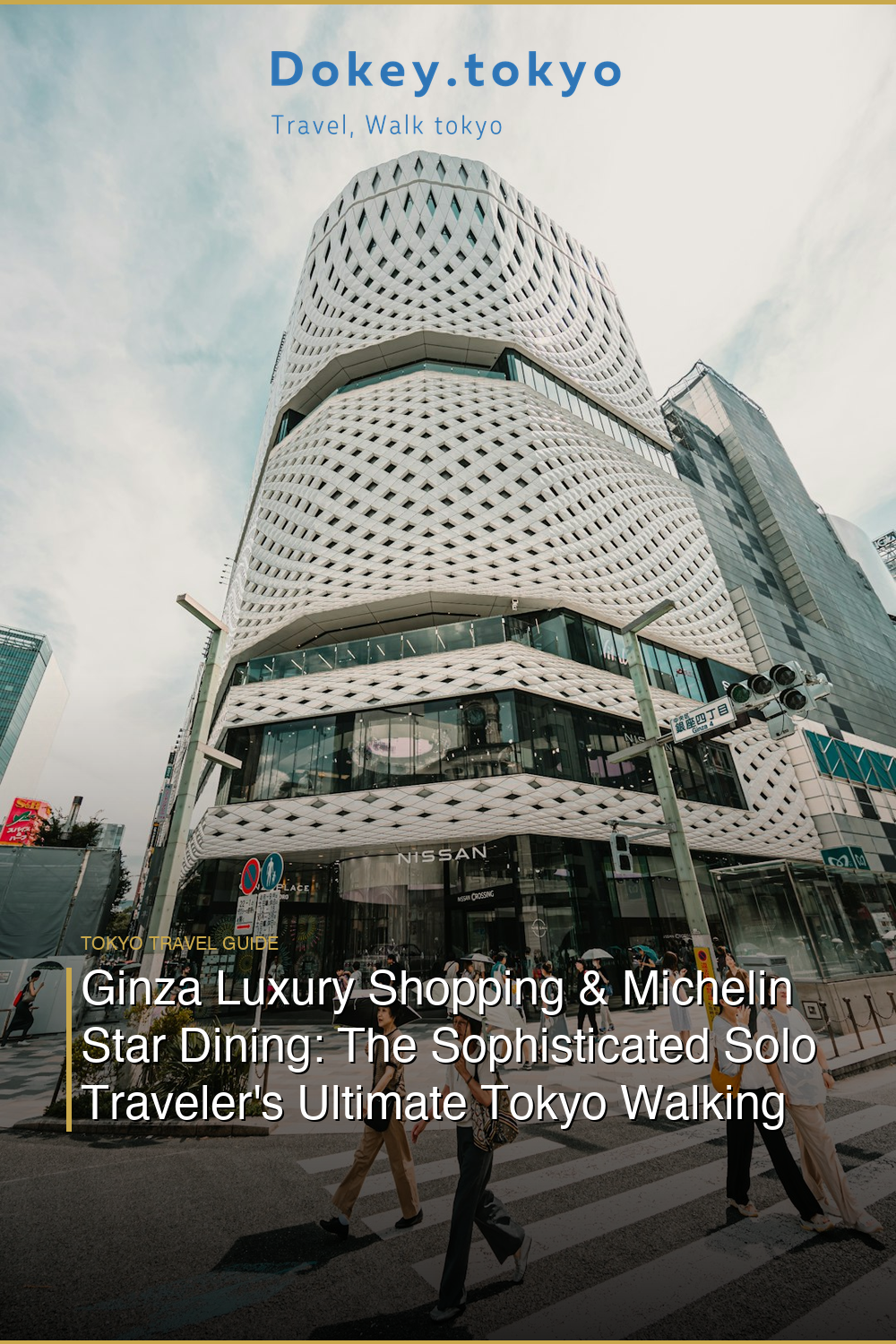
There’s a particular kind of freedom that comes with traveling alone to one of the world’s most luxurious neighborhoods — no compromises, no committee decisions, just you and the gleaming streets of Ginza unfolding exactly at your pace. Ginza is Tokyo’s answer to Paris’s Avenue Montaigne and Milan’s Via Montenapoleone, but with a distinctly Japanese reverence for craft, presentation, and service that elevates the experience into something altogether different. As a solo traveler here, you’re not just shopping and dining — you’re being initiated into a culture where excellence is quietly, almost devotionally, pursued.
I still remember the first time I stepped out of Ginza Station on a crisp October morning. The air carried the faint sweetness of roasting chestnuts from a vendor on the corner, and the low autumn light caught the glass facades of the Chanel and Hermès towers in a way that made them look less like stores and more like luminous sculptures. I stood there for a full minute, clutching my tote bag, feeling simultaneously underdressed and completely electrified.
Why Ginza Is Perfect for the Solo Sophisticated Traveler
Ginza rewards the solo traveler in ways group travel simply cannot. You can linger in a gallery for two hours because a particular photograph stopped you cold. You can make a last-minute reservation at a counter-seat sushi bar — the kind that only has eight seats and wouldn’t dream of accommodating a party of four. You can window-shop at your own contemplative pace, which is, honestly, the only pace Ginza respects.
The district runs along Chuo-dori, its main artery, but the real discoveries happen when you slip into the numbered side streets — Ginza 1-chome through 8-chome — each with its own personality. As a solo traveler, you become fluent in these streets faster than you’d expect.
The Luxury Shopping Circuit: Where to Go and What to Actually Buy
The Flagship Boutiques Worth Your Time
Ginza’s flagship stores are not merely retail spaces — they are architectural statements. The Hermès Maison Ginza, designed by Renzo Piano, is clad in glass bricks that glow amber at dusk like a lantern. Even if you’re browsing rather than buying, the top-floor Ginza Forum gallery space often hosts thoughtful art exhibitions that are free to enter. The Louis Vuitton Ginza Namiki store is worth a visit for its rotating art installations alone.
For something more distinctly Japanese in its luxury, don’t miss Mikimoto on Chuo-dori, the iconic pearl house founded right here in Ginza. Solo travel gives you the unhurried space to actually have a conversation with the sales associates, who are extraordinarily knowledgeable and refreshingly non-pushy. Ask them about the difference between Akoya and South Sea pearls — you’ll learn more in ten minutes than any article can teach you.
Curated Concept Stores and Japanese Design
Dover Street Market Ginza is a must for the design-literate solo traveler. Spread across seven floors, it curates fashion, art, and objects with an editorial sensibility that feels genuinely surprising. I once spent an entire afternoon here, which I hadn’t planned at all — a staff member quietly mentioned that the basement housed a Rei Kawakubo-curated installation that wasn’t on the website yet, and she was right. That’s the kind of discovery that only happens when you’re alone and unhurried.
Itoya, the legendary stationery store on Chuo-dori, is an absolute non-negotiable. Twelve floors of the world’s finest paper goods, fountain pens, and travel accessories. Solo travelers with any appreciation for journaling or writing will lose themselves here — in the best possible way. Their rooftop café serves excellent coffee while you examine your new purchases.
Michelin-Star Dining: Eating Extraordinarily Well Alone in Ginza
Sushi Counter Culture — The Solo Diner’s Greatest Gift
Ginza is home to some of the most decorated sushi restaurants on the planet, and the omakase counter format was practically invented for the sophisticated solo traveler. Seated directly in front of the itamae (head chef), you become the sole focus of an artisanal performance that can last two to three hours.
Sushi Yoshitake (three Michelin stars) is one of the most acclaimed experiences in the city. Bookings open months in advance and require a credit card guarantee, so plan this before you even book your flights. The omakase here runs approximately ¥35,000–¥45,000 per person and is worth every yen. The nigiri arrives one piece at a time — lean tuna, then medium-fatty, then otoro — each seasoned with a precise application of soy that the chef brushes on himself, so you eat immediately, as instructed with a gentle nod.
Sushi Saito and Sushi Sho are similarly legendary, though reservations are famously difficult without a Japanese-speaking contact or a concierge at a five-star hotel. If you’re staying at The Peninsula Tokyo or The Mandarin Oriental — both a short walk from Ginza — leverage your concierge team aggressively. That’s what they’re there for.
Beyond Sushi: Kaiseki and French-Japanese Excellence
For dinner, consider Kagurazaka Ishikawa or, staying strictly within Ginza, Kojyu — a stunning kaiseki restaurant where chef Toru Okuda presents seasonal Japanese cuisine in a setting so serene you’ll feel your nervous system actually downregulate. The course changes with every season; if you visit in autumn, expect matsutake mushrooms prepared in ways that will rearrange your understanding of what a mushroom can taste like.
For something with a French accent, Robuchon à la Maison in nearby Ebisu or the excellent French-Japanese fusion at L’Osier in Ginza itself offer world-class tasting menus in formal dining rooms where solo diners are treated with complete dignity — another reason I’ll always advocate for Ginza over more tourist-worn neighborhoods.
Afternoon Tea and Cocktail Hour
Between a morning of shopping and an evening of omakase, solo travelers need an elegant pause. The Lobby Lounge at The Peninsula Tokyo serves an afternoon tea that is genuinely one of the finest I’ve experienced outside London — finger sandwiches filled with Hokkaido crab, matcha scones with clotted cream, and a rotating selection of single-origin Japanese teas presented in a pot that’s refilled without you ever having to ask.
For cocktails as the sun sets over Chuo-dori, Bar Orchard Ginza specializes in fruit-forward cocktails made with seasonal Japanese produce. The yuzu gin sour made with fresh-pressed yuzu is not on the printed menu — ask the bartender if yuzu is in season and watch his face light up.
Cultural Depth: What Solo Travelers Miss If They Only Shop
Ginza has a cultural soul that gets overlooked beneath the luxury gloss. The Ginza Six complex houses the Kanze Noh Theater in its basement — yes, a traditional Noh theater beneath a luxury mall, which is somehow perfectly Tokyo. Check their schedule because performances are open to visitors and require no Japanese to appreciate the slow, haunting beauty of the form.
The Shiseido Gallery on Ginza 8-chome is free and consistently presents some of the most interesting contemporary art in Tokyo, curated by one of Japan’s most important beauty companies with a genuine and longstanding commitment to art patronage.
Practical Tips for the Solo Sophisticated Traveler
Best time to visit: October and November offer the perfect Ginza experience — mild temperatures, occasional golden-hour light on the glass towers, and the seasonal menus at kaiseki restaurants are at their most theatrical with autumn ingredients.
Getting around: Ginza Station connects multiple subway lines. Walk Chuo-dori on Sunday afternoons when it becomes a pedestrian promenade — no cars, just people and storefronts and space to breathe.
Dress code awareness: While Ginza is not formally dress-coded outdoors, you’ll feel most comfortable — and be taken most seriously in boutiques — in smart-casual to business-casual attire. For Michelin-star dinner, dress as you would for a fine restaurant in Paris or New York.
Reservations: Book omakase restaurants 60–90 days in advance. Use Tableall, Omakase, or your hotel concierge. Never show up without a reservation at a serious counter.
Budget reality: A full day in Ginza — afternoon tea, museum visit, luxury browsing, and an omakase dinner — can run ¥60,000–¥120,000 ($400–$800 USD) without shopping purchases. Plan accordingly and consider it the price of an experience genuinely unlike anywhere else on earth.
It was nearly 10pm on my last visit when I finally stepped out of Sushi Yoshitake into the quiet Ginza night, the taste of that final piece of tamago — the chef’s traditional sign-off, sweet and perfectly dense — still resting on my palate. The streets had emptied, the boutique windows glowed with their silent displays, and I walked the length of Chuo-dori alone, past the locked Hermès lantern and the darkened Mikimoto pearl cases, feeling the particular satisfaction of a day lived entirely without compromise.
Final Thoughts: Solo Travel and the Ginza State of Mind
Ginza doesn’t ask you to hurry or to justify your choices or to explain why you just spent three hours in a stationery store before a three-Michelin-star dinner. It meets your standards because it holds its own so ferociously high. For the sophisticated solo traveler, that silent contract — between a neighborhood and a person who shows up ready to pay full attention — is the greatest luxury of all. Book the flight. Make the reservations. Walk slowly. Ginza will take care of the rest.