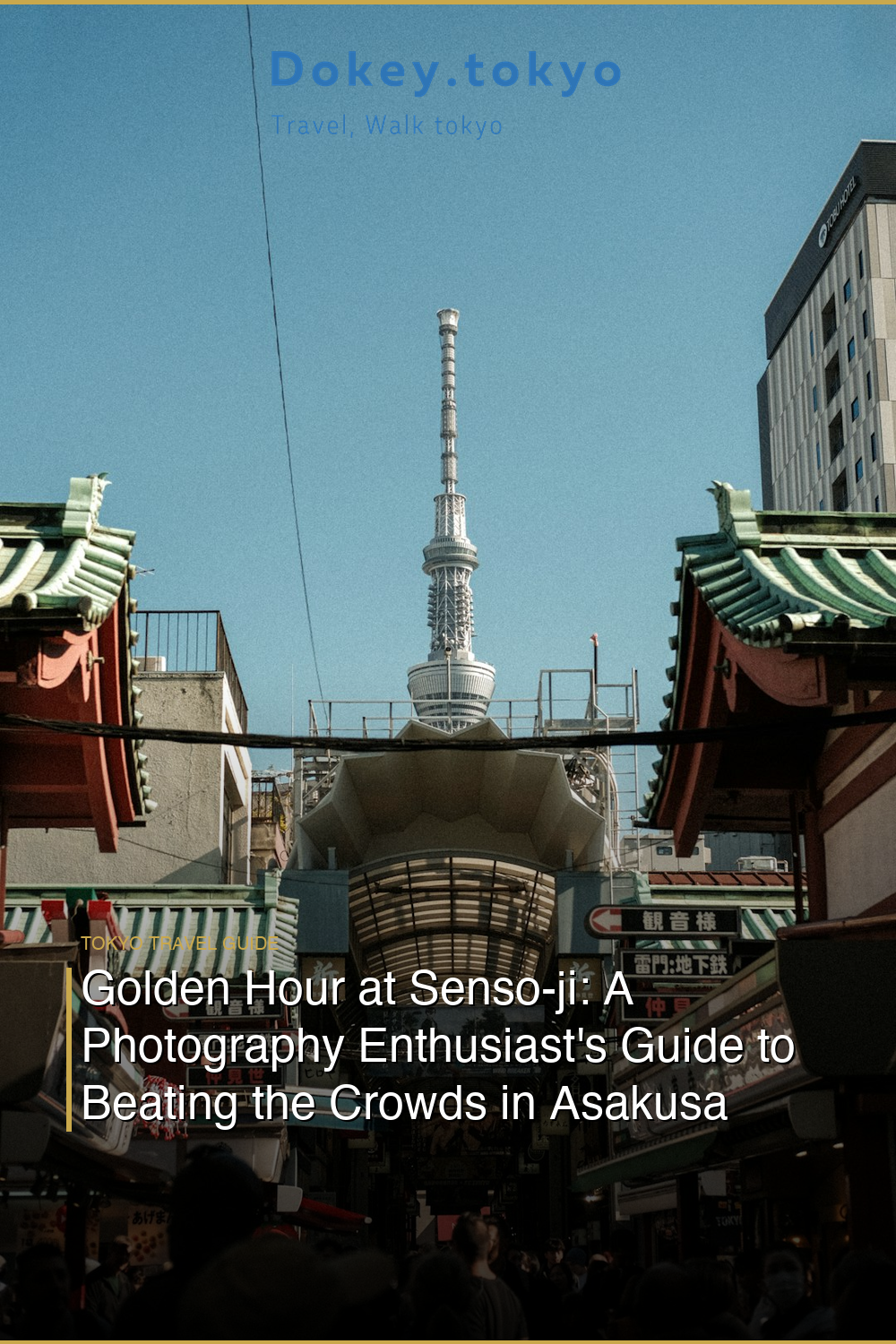
There’s a version of Senso-ji Temple that most tourists never see — and it’s the one worth waking up at 4:30 a.m. for. By the time the first tour buses roll into Asakusa around 8 a.m., the magic has already started to thin. But in those hushed hours before the souvenir stalls shake open their metal shutters, Senso-ji belongs to the monks, the elderly worshippers, and — if you’re smart enough to set an early alarm — you and your camera.
I remember my first pre-dawn arrival at Kaminarimon Gate like it was burned into my memory card. It was late October, maybe 5:15 a.m., and a thin river fog had rolled in off the Sumida overnight. The giant red lantern glowed in the mist like an ember, and the only sound was the soft scrape of a street cleaner’s broom somewhere down Nakamise-dori. The air smelled of cool stone and something faintly woody — cedar, maybe, or the first whisper of incense drifting from the main hall. I stood there for a full two minutes without lifting my camera, just breathing it in.
Why Sunrise Is a Photographer’s Golden Ticket to Senso-ji
Senso-ji is Tokyo’s oldest temple, built in 628 AD, and on a normal afternoon it sees upwards of 30,000 visitors. That’s not a typo. The five-storied pagoda, the Hozomon Gate, the main hall (Kannon-do) — every iconic frame is typically blocked by selfie sticks, tour group flags, and matching luggage sets. But arrive between 5:00 and 6:30 a.m. and the geometry of the place opens up completely.
The mathematics of early morning light here are almost unfair in how beautiful they are. Tokyo faces east, and Senso-ji’s main hall is oriented so that the first horizontal rays of sunrise rake directly across the front facade. The stone lanterns lining the approach cast long, dramatic shadows. The copper roof tiles shift from grey to green to a burnished gold as the light climbs. If you shoot in RAW format and arrive 20 minutes before official sunrise, you’ll catch the blue-hour glow on the Nakamise shopping street that makes the stone path look like it leads somewhere eternal.
What to Shoot and Where to Stand
Kaminarimon Gate (Thunder Gate): Position yourself on the southern end of the approach, low to the ground with a wide-angle lens. From ground level, the lantern becomes monumental. At 5 a.m. in summer, you’ll have it entirely to yourself. In winter, there’s sometimes a thin frost on the pavement that reflects the red.
Nakamise-dori (The Shopping Street): Completely empty at dawn — all 89 stalls shuttered with identical wooden panels. This actually makes for better compositions than the daytime chaos. The repetition of the closed stalls creates leading lines that pull your eye straight toward Hozomon Gate in the background. It looks almost like a film set.
The Main Incense Cauldron (Jokoro): This is where things get genuinely moving. Elderly worshippers arrive early — some before 6 a.m. — and they know exactly what they’re doing. They fan the smoke toward their bodies with both hands, directing it over arthritic knees or aching shoulders, believing it carries healing properties. The smoke itself is endlessly photogenic: it curls and billows unpredictably, and when a shaft of morning light hits it at the right angle, individual smoke tendrils glow like silver thread against the dark wood of the main hall.
The Pagoda at Dawn: Walk around to the left of the main compound, past the smaller Asakusa Shrine (Asakusa Jinja), and find the angle where both the five-storied pagoda and the main gate appear in the same frame. Almost nobody knows this vantage point. A gardener named Tanaka-san pointed it out to me on my third visit, gesturing with his rake and saying simply, “Ii kanji” — roughly, “good feeling.” He was right. It’s the frame that’s made it onto more magazine covers than I can count.
The Human Element: Photographing Worshippers Respectfully
🗾 Book on Viator: Temples, Culture & Modern City Highlight →
This section matters as much as any technical tip. Senso-ji is not a tourist attraction — it is an active place of Buddhist worship, and the people you’ll photograph at 5:30 a.m. are there to pray, not to pose. A few principles that have served me well:
Ask with your eyes, not just your lens. Before photographing anyone directly, make eye contact and give a small nod. Most regular morning worshippers have seen photographers before and will either nod back (yes) or look away (no). Honor that communication.
Shoot from the hip or use a longer focal length. A 85mm or 100mm lens lets you capture authentic moments from a respectful distance without intruding on the intimacy of someone’s morning prayer. The compression also creates beautiful backgrounds.
The fortune-slip ritual is gold. Watch for worshippers drawing omikuji (fortune slips) from the wooden drawers near the main hall. The moment of reading — the slight smile, the quiet exhale, the careful folding — is one of the most genuinely human things you can photograph anywhere in Tokyo.
Camera Settings for the Low-Light Morning Hours
Bring a tripod — there’s no rule against them in the outer courtyard before the crowds arrive. For the incense smoke, I shoot at f/5.6 with a shutter speed around 1/200s to freeze the tendrils rather than blur them. For architecture in blue hour, I drop to ISO 400, f/8, and let the shutter drag on the tripod. Bring a small LED panel if you want to do any close portrait work — harsh on-camera flash will ruin both the photo and your relationship with every monk in the vicinity.
After the Shoot: Fueling Up in Asakusa
By 7 a.m., you’ll have shot for nearly two hours and your stomach will be making its own demands. Here’s where the morning gets even better.
Asakusa Kagetsudo opens early and is famous for its jumbo ningyo-yaki — those little fish-shaped or bell-shaped cakes filled with sweet red bean paste. They cost about ¥100 each, they’re served warm, and eating one while standing on the empty street with steam rising from the pastry and your camera bag still warm from the shoot is a specific kind of happiness that I can’t fully explain in words.
For something more substantial, walk five minutes north to Sometaro, which specializes in okonomiyaki (savory pancakes) and opens surprisingly early on weekends. Order the negi (green onion) version and eat it at the iron griddle table while scrolling through your morning’s shots. The Asakusa version is crispier around the edges than Osaka-style — almost lacy — and the bonito flakes on top wave in the steam from your tea like they’re alive.
There are also small vending machines near the Sumida River park entrance selling hot canned amazake (sweet fermented rice drink) for ¥120. On a cold morning, wrapping both hands around that warm can while watching the river slowly lighten from black to silver — that is the real Tokyo, and it costs almost nothing.
I was standing at exactly one of those vending machines on a February morning when the 6:00 a.m. temple bell rang — a single, resonant, chest-deep tone that seemed to vibrate in the soles of my boots. A woman in a charcoal kimono walked past me on the path, her wooden geta clicking a slow rhythm on the stone, and she glanced at my camera bag and gave the tiniest smile — one professional to another, maybe, or just someone who understood why a person would be out here in the cold before the city woke up. That single bell tone, that click of wooden sandals, that knowing smile — that’s the photograph I’ll never actually have, because I was too busy experiencing it to lift my camera.
Practical Tips for the Early Morning Visit
- Arrival time: 5:00–5:30 a.m. in summer (sunrise around 4:30 a.m.); 5:30–6:00 a.m. in autumn and spring; 6:00–6:30 a.m. in winter (sunrise around 6:45 a.m.)
- Getting there: Take the Tokyo Metro Ginza Line to Asakusa Station (last train runs until about 12:30 a.m., first train around 5:00 a.m.). Alternatively, walk 15 minutes from Asakusa along the river — the approach on foot is gorgeous.
- What to wear: Comfortable, quiet shoes (no flip-flops slapping on stone); layers in any season; a dark jacket so you blend rather than announce yourself.
- Tripod rules: Permitted in the outer courtyard. Not permitted inside the main hall.
- Etiquette: Remove your shoes before entering any indoor shrine space; keep voices low; turn off camera sounds or use silent mode.
- Best seasons for photography: Late March to early April (cherry blossoms in Sumida Park, five minutes walk); mid-November (autumn foliage around the temple grounds); any clear morning after light snowfall in January or February.
The Reason You’ll Come Back
Every photographer I’ve ever brought to Senso-ji at sunrise has said the same thing on the walk back to the station: they want to come back tomorrow. Not because they missed any shot, but because the place does something to you in the early morning quiet that feels impossible to fully capture — and that impossibility is exactly what keeps you reaching for the camera. Tokyo is relentlessly modern and kinetic, and Senso-ji at dawn is its counter-argument: ancient, unhurried, and wholly itself. Set your alarm. Charge your batteries. This is the shot.
Ready to experience it?
🗾 Book on Viator: Local Guide, Custom Stops & Hidden Gems →