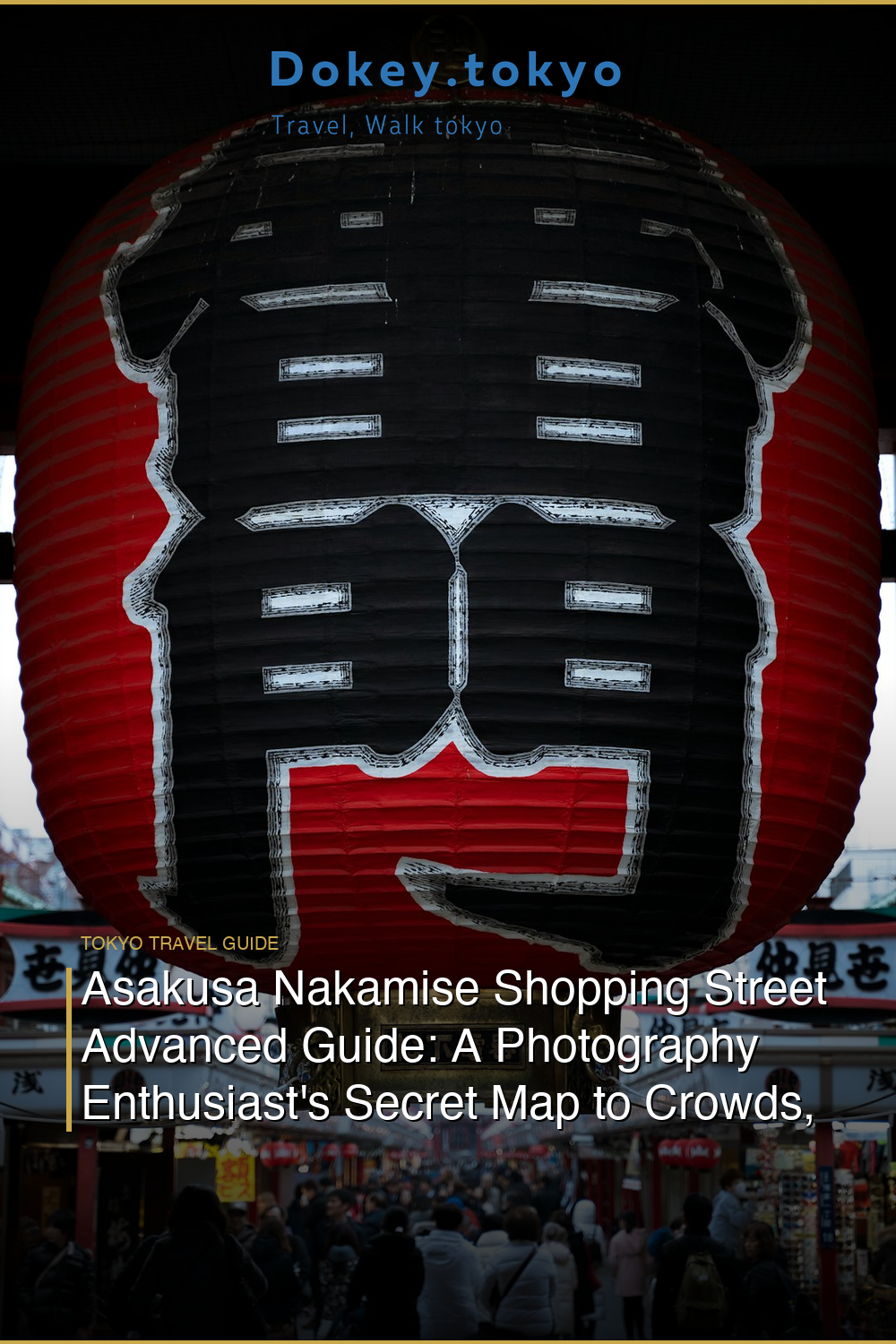
There’s a version of Nakamise Shopping Street that most tourists never see. It’s not the one plastered across travel Instagram — the straight-down-the-barrel shot of red lanterns and matching stalls stretching toward Senso-ji’s Kaminarimon gate, taken at noon in flat, unforgiving light while a river of selfie sticks bobs overhead. The real Nakamise — the one that will genuinely stop your breath and make your shutter finger twitch — exists in the margins: in the amber glow of early morning before the crowds arrive, in the smoky backstreets running parallel to the main drag, in the face of a 70-year-old sembei vendor who has been pressing rice crackers over the same charcoal brazier for forty years.
The first time I turned onto Nakamise at 6:45 a.m. on a crisp October morning, the street was nearly empty and the low autumn sun was cutting in from the east at a hard diagonal angle, gilding every paper lantern a deep burnt orange. I could smell charcoal smoke and something faintly sweet — probably ningyo-yaki batter just beginning to heat up on the griddles — and the sound was nothing but my own footsteps on the stone pavement and a single crow announcing himself from the temple roof. My 35mm prime lens was already on the camera before I even consciously decided to shoot.
Understanding the Light: When to Arrive for the Best Shots
If you remember only one thing from this guide, let it be this: Nakamise is a morning street. The architecture runs roughly north to south, which means the eastern light in the early hours creates dramatic side-lighting across the traditional shopfronts, catching the texture of wooden eaves, the embroidered fabric of hanging noren curtains, and the steam rising from freshly made snacks. By 10 a.m., that magic is largely gone — replaced by overhead light that flattens everything and crowds that fill your foreground with baseball caps and rolling suitcases.
The Golden Window
- Weekdays, 6:30–8:30 a.m.: The absolute sweet spot. Shops begin opening around 7 a.m., so you’ll catch vendors arranging displays — arguably the most photogenic 20 minutes of the entire day.
- Weekends, 6:00–7:30 a.m.: Crowds build faster on weekends, so arrive 30 minutes earlier.
- Blue Hour (pre-dawn): If you’re willing to set a 5 a.m. alarm, the lanterns are illuminated before dawn and the street lamps cast a gorgeous warm contrast against the deep blue sky. Bring a tripod — it’s technically legal here at that hour with minimal pedestrian disruption. For similar early-morning photography experiences elsewhere in Tokyo, check out our guide to photographing Senso-ji at golden hour.
- Evening after 6 p.m.: Most stalls close, but the Kaminarimon gate lantern is lit and the quieter atmosphere allows long-exposure shots of the gate and surrounding architecture without a tourist avalanche in the frame.
The Hidden Lanes Every Photographer Needs to Know
The main 250-meter strip of Nakamise-dori is only the beginning. The streets running parallel on both sides — particularly the Shin-Nakamise arcade to the west and the narrow unnamed alleys directly east of the main drag — are where the genuinely textured, unposed images live.
East Side Alley (Between Nakamise-dori and Asakusa Orange Street)
This tight corridor is lined with older, less renovated shopfronts, some of which look virtually unchanged since the 1950s. Look for the shop selling hand-painted wooden daruma figures — the owner, a small man who always wears a grey work apron, arranges his stock in cascading rows of red and white that photograph beautifully in the morning side-light. I once spent 25 minutes just shooting the reflection of lanterns in his glass display case.
Demboin Street (Denboin-dori)
Running perpendicular to Nakamise on the north end, Demboin Street is Asakusa’s most stylishly art-directed block — the shopfronts are designed to evoke Edo-period aesthetics with hand-lettered signage, wooden lattice screens, and staff in period-appropriate clothing. It’s slightly more staged than the eastern alleys, but the intentional design makes for exceptionally clean, graphic compositions.
The Nakamise Back Approach via Hanayashiki
If you enter Nakamise from the north (from Senso-ji heading south toward Kaminarimon, the opposite of how most visitors walk it), you’ll find the crowd density drops noticeably and you’ll be shooting with the light hitting the stalls from the front rather than the back — completely different quality, and you’ll notice details like the hand-stitched fabric signs that face-forward visitors simply never see.
What to Actually Buy (and Eat) as a Photographer in Asakusa
Beyond the camera-worthy compositions, Nakamise offers genuine sensory rewards that will feed your creativity — and your stomach.
Ningyo-yaki: The Smell That Stops You Cold
These small cakes filled with sweet red bean paste are shaped like temple bells, lanterns, and the iconic Kaminarimon gate, and they are cooked to order on cast-iron griddle molds right in front of you. The smell of the cooking batter — buttery, slightly eggy, with a faint caramel edge — drifts across the street and is genuinely impossible to resist. Beyond the eating, the making of ningyo-yaki is one of the best process photography opportunities on the street: the vendor’s practiced hands, the steam rising from the mold, the golden brown cakes being flicked out with a bamboo pick.
Sembei (Rice Crackers): Find the Charcoal Vendor
Most sembei on Nakamise are pre-packaged, but one stall near the southern end — look for the small charcoal brazier and the hand-lettered price board — still grills to order. On my third visit to this particular stall, I finally worked up the nerve to ask the vendor if I could photograph her hands while she worked. She laughed, said “dozo” (go ahead), and proceeded to give me the most naturally lit portrait session I’ve ever stumbled into, completely unprompted.
Kaminarimon Gate Area: The Props Shop
On the eastern side of the gate approach, there’s a small shop selling traditional tenugui hand towels with Edo-era woodblock designs. These make extraordinary flat-lay photography props — and at ¥600–¥1,200 each, they’re among the most affordable, authentic, and packable souvenirs in the entire district.
Crowd Management Strategies for Photographers
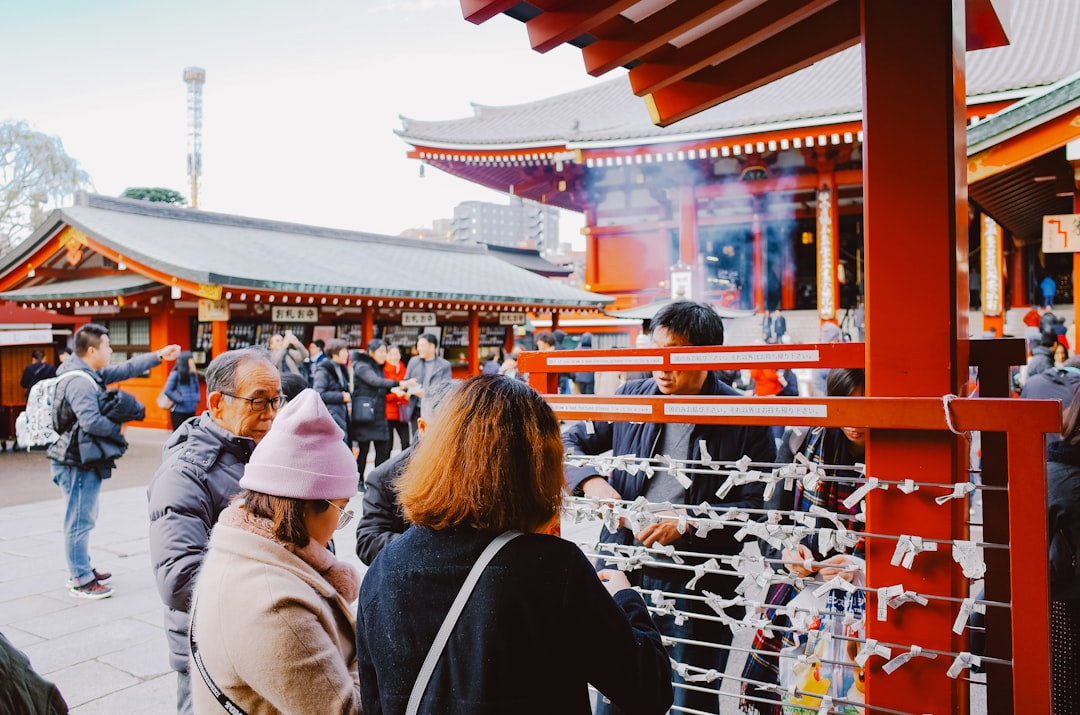
Nakamise on a weekend afternoon in peak season (late March during cherry blossom, October–November during autumn foliage, and the New Year holiday period) can see upward of 90,000 visitors per day. Here’s how to work with — and around — the density.
Compose Crowds INTO Your Shots
Instead of fighting the crowds, use them as compositional elements. A long exposure (1/8 second to 1/4 second, use a small aperture or ND filter) will blur moving pedestrians into soft, ghostly streaks beneath sharp lanterns and architecture — transforming the busiest midday hour into an artistic asset.
The Compression Telephoto Trick
Bring a 70–200mm or equivalent telephoto lens. From the far south end of the street near Kaminarimon, a compressed telephoto shot stacking the lanterns, shopfronts, and the distant Senso-ji pagoda in the background creates an image that looks unlike any standard Nakamise photograph — and it requires no crowd-clearing to execute because you’re shooting with the depth.
Vertical Shooting for Architectural Detail
Switch to a vertical orientation and look up. The decorative roof tiles, hand-painted shop signs, and the way the lanterns hang in descending scale toward the horizon are details most horizontal wide-angle shots completely discard. Some of my most-engaged photographs from Asakusa are simple verticals of a single wooden eave corner with a lantern fringe below.
Practical Details for Photography Enthusiasts
- Getting there: Take the Ginza Line or Asakusa Line to Asakusa Station; the main Kaminarimon gate is a 2-minute walk from Exit 1.
- Tripod policy: Tripods are generally tolerated in early morning low-traffic hours but will draw complaints (and occasionally requests to stop) during busy periods. A Gorillapod or small tabletop tripod is more practical and less conspicuous.
- Battery and storage: Bring extra batteries in cold weather (November–February); the cold drains batteries fast and you will shoot more than you expect.
- Rain: Don’t skip Nakamise in the rain. The wet stone pavement creates mirror-like reflections of the lanterns and shopfronts that are genuinely extraordinary — and the crowds thin dramatically.
I’ll tell you about the moment that sealed Nakamise’s place in my permanent rotation of favourite shooting locations: it was a Tuesday in early November, about 7:15 a.m., and a light fog had settled over the entire district overnight, thinning just enough by morning to create a soft diffusion without obscuring detail. An elderly man in a deep indigo happi coat was arranging bamboo fans in a wooden crate outside his shop, and the mist was catching the light behind him in a way that made the whole scene look like a hand-tinted postcard from 1930. I took one shot. When I looked at it on the LCD screen, the man glanced over, smiled, and said nothing — just nodded once, as if he already knew.
Final Thoughts: Slow Down to See More
Nakamise Dori rewards the patient observer more than almost any other street in Tokyo. The photographers who come away with the most compelling images are never the ones who power-walk the 250 meters in 15 minutes between Instagram check-ins — they’re the ones who return on multiple mornings, who learn which vendor’s hands tell the best story, who notice that the light at 7:05 a.m. is categorically different from the light at 7:40 a.m. Come early, come back often, and point your lens at the things everyone else is walking past. That’s where Nakamise’s real treasures are hiding.