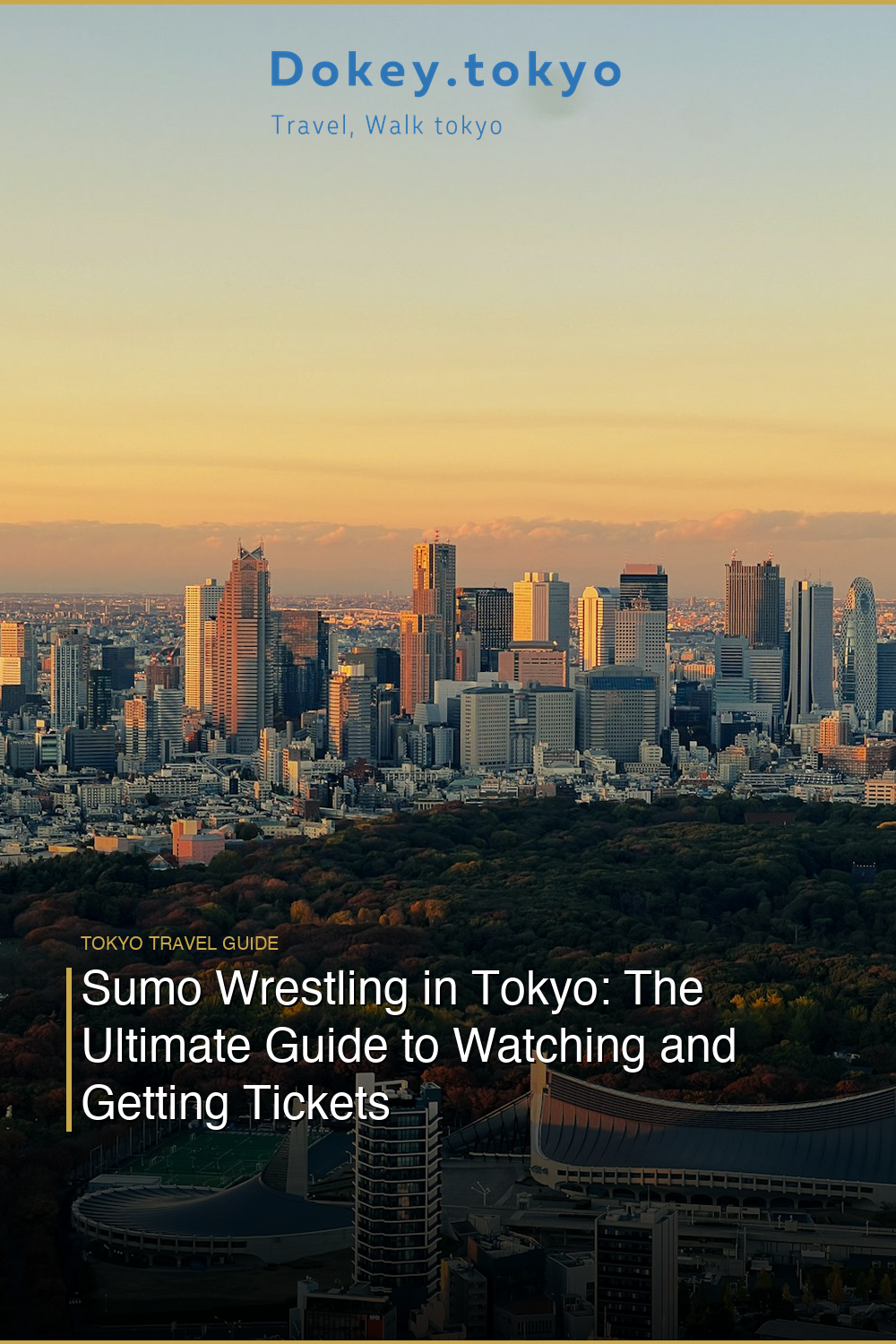
There’s a moment — and if you’ve never experienced it, trust me, it’s coming — when two enormous wrestlers lock eyes across a small circle of clay and the entire arena goes completely silent. Not politely quiet. Silence. The kind that presses against your eardrums. Then they crash into each other with a sound like a car door slamming, and 10,000 people erupt at once. That is sumo wrestling live in Tokyo, and no YouTube video, no travel documentary, absolutely nothing prepares you for it. If you’re visiting Tokyo for the first time and you have even a flicker of curiosity about this sport, I’m telling you right now: go. Clear a day. Make it happen. You will not regret it.
The first time I walked into Ryogoku Kokugikan — Tokyo’s grand sumo arena — it was a drizzly January morning and the place smelled like cedar wood, fried chicken, and something sweet I couldn’t identify yet (more on that later). I remember stopping just inside the main entrance, completely overwhelmed by the scale of it: the circular roof hanging above the dohyo like a Shinto shrine suspended in mid-air, the rows of cushioned box seats spreading out in every direction, vendors in traditional happi coats weaving through the crowd with trays of hot food. I had no idea what I was doing. I just knew I was exactly where I needed to be.
Understanding the Sumo Tournament Calendar
Before you book anything, the single most important thing to know as a first-time visitor is this: sumo tournaments in Tokyo only happen three times a year. Miss the window and you’ll be watching highlights on your phone in your hotel room.
The three Tokyo tournaments — called basho — take place at Ryogoku Kokugikan in:
– January (the Hatsu Basho)
– May (the Natsu Basho)
– September (the Aki Basho)
Each tournament runs for 15 consecutive days, always starting on a Sunday. This means if your Tokyo trip falls in, say, March or July, you won’t catch a tournament at the main arena. However — and this is important — don’t panic. There are still ways to experience sumo outside tournament season, which I’ll cover below.
For first-timers, my honest recommendation is the January or September tournament. January is a special atmosphere because it kicks off the sumo year with extra ceremony and fanfare. September is wonderful because the weather is still warm, the city feels energetic, and crowds are slightly more manageable than the wildly popular May basho.
Where to Watch: Ryogoku Kokugikan
Ryogoku Kokugikan in the Ryogoku neighborhood of Sumida is the place. There’s nowhere else for tournament sumo. The arena holds around 11,000 people and has been the spiritual home of professional sumo since 1985. Getting there is straightforward — take the JR Sobu Line to Ryogoku Station (about 10 minutes from Akihabara), and you’ll literally walk out of the station and see the distinctive roof of the arena in front of you.
The surrounding Ryogoku neighborhood is worth arriving early for. This is sumo country. You’ll spot enormous wrestlers — called rikishi — walking casually to the arena in their traditional robes and wooden sandals, their hair pinned up in the iconic topknot. I once nearly walked into a yokozuna (that’s the highest rank in sumo) outside a convenience store. He was buying a rice ball. We made eye contact. I forgot how to speak Japanese entirely.
What the Day Actually Looks Like
Here’s something most first-timers don’t know: the tournament day runs from about 8:00 AM to 6:00 PM, and lower-division wrestlers compete in the morning while the elite upper-division wrestlers (the ones you came to see) perform in the afternoon. The atmosphere builds steadily throughout the day, hitting its electric peak between 3:30 PM and 6:00 PM when the top-ranked wrestlers compete.
You don’t have to arrive at 8 AM. Arriving around 2:00 PM gives you a fantastic experience — you catch the rising energy, the increasingly packed arena, the ceremony-heavy upper-division bouts, and you don’t need to commit to a full 10-hour day. For first-time visitors who aren’t sure how long their attention will hold, this is the sweet spot.
How to Get Sumo Tickets in Tokyo
This is where many first-timers stumble, so let me break it down clearly.
Official Ticket Options
Box seats (masu-seki): These are the traditional square floor seats close to the dohyo. You sit on cushions with a small wooden border separating your group’s square from your neighbors’. They’re sold in groups of four and include a bento lunch box and snacks. They feel incredibly immersive — you’re close to the action, surrounded by locals — but they’re also the first to sell out. Prices run roughly ¥9,500–¥11,000 per person.
Arena seats (isu-seki): Standard Western-style chairs in the upper tiers. Much easier to get, cheaper (around ¥3,800–¥14,800 depending on level), and perfectly comfortable for first-timers. Honestly, for your first time, upper arena seats are completely fine. The view is excellent and you can see the entire dohyo without craning your neck.
Same-day tickets: A limited number of unreserved same-day tickets go on sale at the arena box office starting at 8:00 AM. They’re cheap (around ¥2,200) and standing room only, but they absolutely exist. If you’re traveling without a fixed itinerary, this is a viable option — just queue early.
Where to Buy in Advance
The most reliable English-friendly option for first-timers is the Japan Sumo Association’s official website (sumo.or.jp) or through Ticket Pia (pia.jp). Both sell tickets in advance, though popular tournaments sell out weeks ahead. A tip I swear by: set a calendar reminder for exactly two months before the tournament start date — that’s typically when tickets go on general sale.
If you’ve missed the official sale, Voyagin and Klook often have bundled ticket experiences with English guides, which are genuinely useful for first-timers who want context explained in real time. They’re pricier but worth it if this is your only sumo experience and you want to actually understand what you’re watching.
During my third visit to a basho, I ended up squeezed into a masu-seki box with a retired salaryman named Kenji who had attended every January tournament for 22 years straight. He slid a cup of warm sake toward me without asking, pointed at a wrestler entering the arena, and said simply, “That one will be yokozuna in three years.” He was right. That kind of moment — that casual, generous local knowledge — is something you only get when you’re sitting on the floor in the box seats.
Food, Drink, and the Sumo Experience
Never go hungry at the sumo. The arena has its own concession stands and vendors circulating through the crowd, and the food is part of the experience. The thing you absolutely must try is chanko nabe — the hearty hot pot stew that is the traditional diet of sumo wrestlers. There are entire restaurants in the Ryogoku neighborhood dedicated to it, and several spots just outside the arena serve it in the hours before and after the tournament.
Inside the arena, grab a yakitori skewer and a cold Super Dry Asahi from the vendors who weave through the crowd. The sweet smell I mentioned at the very beginning? That turned out to be dorayaki — small pancake sandwiches filled with sweet red bean paste — being sold from trays near the entrance. I’ve eaten them at every single tournament I’ve attended since and I’m completely convinced they taste better inside that arena than anywhere else on earth.
Watching Sumo Outside Tournament Season
If your Tokyo dates don’t align with a basho, you still have options. Sumo stables (heya) occasionally open their morning training sessions to visitors — this is called asageiko — and watching wrestlers practice up close, sometimes just meters away, is an extraordinary experience. It requires advance arrangements (often through your hotel concierge or a tour operator), respectful silence, and punctuality, but it’s one of those genuinely rare Tokyo experiences that most tourists never find.
The Japan Sumo Museum inside Ryogoku Kokugikan is small but fascinating, free with an arena ticket or accessible separately on non-tournament days. For first-timers wanting cultural context, it’s a solid 45-minute visit.
Practical Tips for First-Time Sumo Visitors
- Dress comfortably. You may be sitting on floor cushions for hours.
- Bring cash. Many vendors inside the arena are cash only.
- Download the NHK World Sumo app before you go — it has wrestler profiles and rank explanations in English that help you follow along.
- Photography is allowed from your seat throughout the day. The late afternoon light inside Kokugikan, filtering down onto the clay dohyo, is genuinely beautiful.
- Be respectful of the ceremony. The salt throwing, the stomping, the long pre-bout rituals — these are sacred traditions, not theatrical delays. Embrace them.
On my most recent visit, just before the final bout of the day, the arena was so loud I could feel the vibration in my chest. The two wrestlers stood at opposite sides of the dohyo, sweat already on their shoulders from the warmth of the packed crowd, and for one suspended moment everything — the noise, the smell of clay and cedar, the weight of 10,000 people holding their breath — collapsed into something that felt ancient and alive at the same time. I had tears in my eyes and I am not embarrassed about it.
Tokyo is a city of endless layers, and sumo is one of the deepest ones. You don’t need to understand every ritual, every rank, or every rule to feel it. You just need to show up, sit down, and let it hit you. Book the ticket. Go.