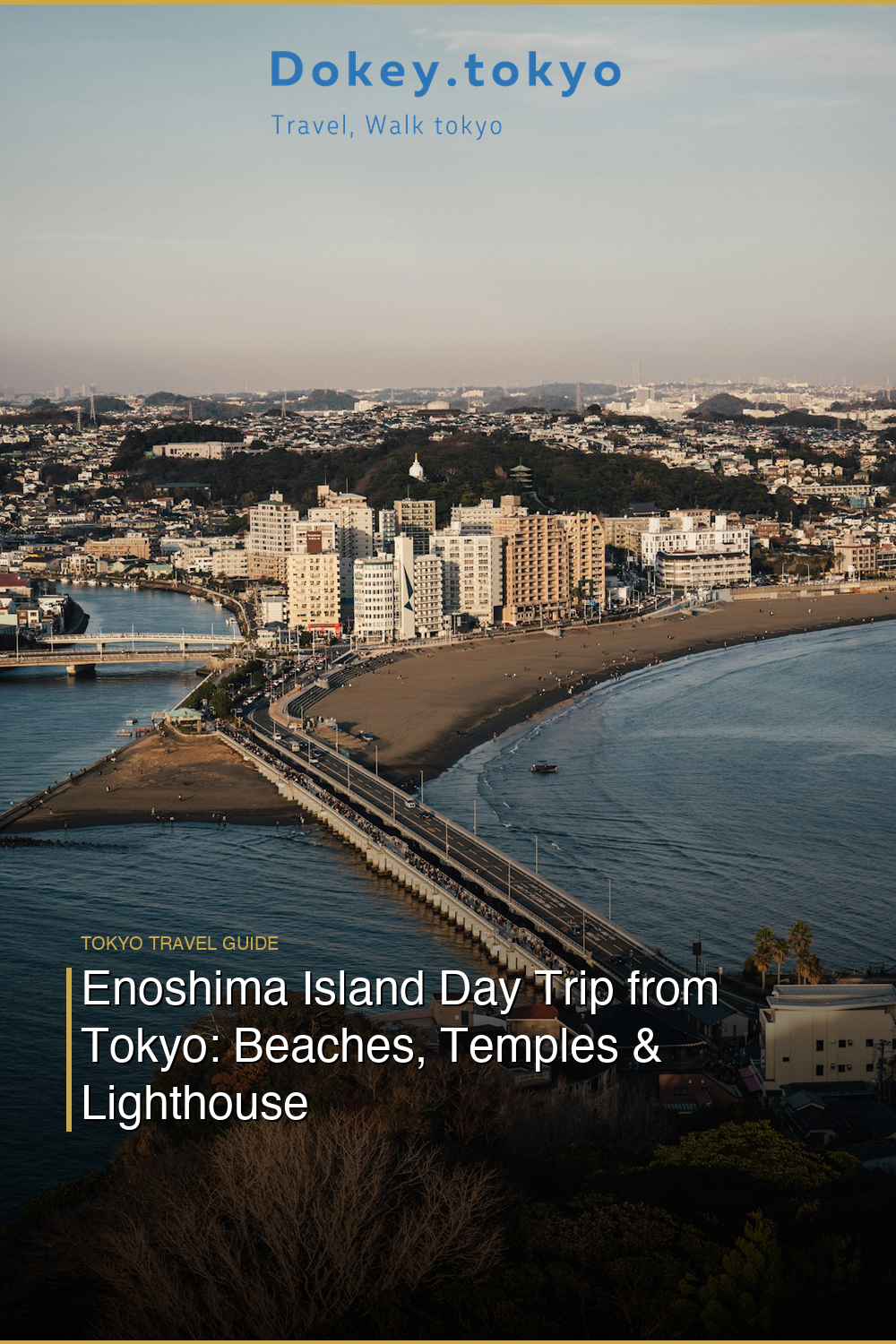
If you’ve spent three days shooting Shibuya Crossing and Senso-ji with every other tourist on the planet, I’m here to tell you: Enoshima Island is the shot you’ve been missing. Just 50 minutes from Shinjuku by the Odakyu Romancecar, this compact little island off the Shonan Coast packs more photographic variety into a single day than most destinations manage in a week — crashing Pacific surf, vermillion torii gates, moss-draped stone staircases, candlelit sea caves, and a lighthouse silhouetted against a sky that turns the color of peach sorbet at dusk.
The first time I stepped off the Enoden tram at Enoshima Station, the salt air hit me before I even saw the water — thick and briny and alive, the kind of smell that makes your lungs feel wider. I walked out of the station at 7:15 a.m. and the low morning light was already slicing through the narrow shotengai (shopping street) in long, dusty gold shafts, catching the steam rising from a tako-senbei (octopus cracker) grill that was just firing up for the day. I stood there for a full minute just breathing it in, knowing my memory card was about to have a very good day.
Planning Your Enoshima Shoot: When to Go and What to Bring
For photographers, timing is everything, and Enoshima rewards those who show up early and stay late. The island faces southwest, which means you get gorgeous soft light in the morning hitting the eastern temple structures, and absolutely explosive golden hour over the ocean from Chigogafuchi (the rocky western coastline) at sunset.
Best Season for Photography
Late October through early December is my personal sweet spot — the autumn haze clears, the crowds thin after the summer beach season ends, and on crisp mornings you get that legendary shot: Mt. Fuji floating above the horizon beyond Enoshima Lighthouse, perfectly framed. I’ve gotten this shot twice in December and failed completely in August when summer humidity turned Fuji invisible. Spring (late March to April) is beautiful for softer, pastel-toned images and occasional cherry blossoms near the island’s approach bridge, but weekends get crowded fast.
What to bring:
– A wide-angle lens (16–35mm equivalent) for the cave interiors and sweeping coastal shots
– A 70–200mm telephoto for compressing Fuji behind the lighthouse
– A small tripod or Gorillapod — the sea caves require long exposures
– Neutral density filters for smooth water shots at Iwaya Caves
– Extra batteries (cold sea air drains them faster than you’d expect)
The Enoshima Approach: Shooting the Bridge and Benzaiten Street
Don’t rush the 600-meter Enoshima Benzaiten Bridge crossing — this is your first composition opportunity. Shoot looking back toward the mainland at sunrise for silhouettes of fishermen against pink-orange sky, or face the island itself to frame the torii gate entrance with the lighthouse tower peeking above the roofline behind it.
Once you’re on the island, Benzaiten Nakamise-dori — the main covered shopping street — is pure visual chaos in the best possible way. Stalls selling shirasu (tiny whitebait fish) bowls, grilled scallops, and sea glass jewelry crowd both sides. The vendors don’t mind being photographed if you make eye contact first and give a small bow — I’ve always found Enoshima’s shopkeepers to be warmer and less camera-shy than those in the more tourist-saturated parts of Tokyo.
Enoshima Shrine Complex: Layers, Light, and Torii Gates
The climb through Enoshima Shrine’s three precincts (Hetsunomiya, Nakatsunomiya, and Okitsunomiya) is a photographer’s layered dream. Stone lanterns line the staircases. Moss creeps over ancient granite. Votive plaques (ema) painted with Benten — the goddess of music and beauty enshrined here — swing gently in the ocean breeze.
Practical Shooting Tips Inside the Shrine
- Arrive before 9 a.m. to shoot the main torii and staircase without crowds blocking your frame
- The inner courtyard of Nakatsunomiya Shrine has a small pond that creates beautiful reflection shots on still mornings
- Look for the cats — Enoshima is famous for its resident shrine cats, and a tabby sleeping in a patch of dappled light against a stone lantern is absolutely peak Japan photography
On my third visit, I discovered something I’ve never seen mentioned in any guidebook: a narrow side alley just past the Hetsunomiya treasure hall that leads to a tiny overlook platform completely obscured by wisteria vines. An elderly man sweeping the path told me quietly, “Fuji ga mieru yo” — ‘you can see Fuji from here’ — and sure enough, on that clear November morning, there it was, a perfect white cone framed perfectly between the wisteria and a stone wall. I shot 200 frames in 20 minutes and nearly missed my feet on the steps walking back down because I couldn’t stop staring at my LCD screen.
Samuel Cocking Garden & Enoshima Lighthouse (Sea Candle)
Pay the ¥500 admission to the Samuel Cocking Garden without hesitation — it grants access to the Enoshima Sea Candle lighthouse, and the 360-degree observation deck is one of the finest photography platforms on the entire Kanagawa coastline. On a clear day you can see: Mt. Fuji to the northwest, the Boso Peninsula curving away to the east, Oshima Island to the south, and the entire sweep of Sagami Bay below you.
The lighthouse exterior is at its most photogenic just before sunset when the warm light turns the white tower amber. Set up wide and include the surrounding garden vegetation in your foreground — it transforms a standard lighthouse shot into something that feels genuinely editorial.
Iwaya Sea Caves: The Underground Money Shot
Don’t leave Enoshima without descending into the Iwaya Caves at the island’s far western end. These are ancient sea caves carved by the Pacific over millennia, and they’re genuinely atmospheric — narrow passages lit by orange paper lanterns, the sound of dripping water and distant waves, the smell of salt and old stone thick in the damp air.
Bring your tripod and set it up in the first cave chamber for a long exposure: the lanterns streak warm gold in the darkness while the rocky tunnel recedes into shadow. It’s one of those shots that looks almost unreal when you nail it, but is completely achievable with a 2–4 second exposure at f/8 and ISO 400.
Practical note: The caves are open until 5 p.m. (4 p.m. in winter). Go in the late afternoon when most day-trippers have already started heading back — you’ll often have the second inner chamber nearly to yourself.
The Street Food Stops You Can’t Skip (And Should Photograph)
Enoshima’s street food is deeply photogenic and genuinely delicious — these aren’t tourist gimmicks. The visual texture of the food stalls alone is worth a dedicated 30-minute shooting session.
- Tako-senbei: Watch the vendor press a whole baby octopus flat between two giant hot irons until it becomes a crispy cracker. The steam and the drama of the press make incredible action shots, and it tastes like the sea in the best possible way.
- Shirasu pizza: Yes, it sounds strange. Yes, it’s extraordinary. The whitebait fish are piled over tomato sauce and melted cheese, served in small personal portions at several spots along the shotengai. Shoot it close — the tiny translucent fish against red sauce is a macro photographer’s delight.
- Enoshima-don: A shirasu rice bowl served at the sit-down restaurants near the bridge. Order the half-raw, half-cooked version (hama don) for the textural contrast and the visual drama of the glistening raw fish next to the golden sautéed.
Getting There: The Enoden Tram Is Part of the Experience
From Shinjuku, take the Odakyu Line to Katase-Enoshima (about 65 minutes, ¥580 with the Odakyu discount day pass). OR take the JR Shonan-Shinjuku Line to Fujisawa, then transfer to the charming Enoden (Enoshima Electric Railway) — a vintage-style tram that rattles along the Shonan beachfront past surfers and beachside cafes. The Enoden stretch between Kamakura-Kōkōmae and Enoshima is one of the most photographed train lines in Japan — shoot from inside the tram as it hugs the coastline with the ocean filling the windows behind passing passengers.
As the sun finally dropped below the horizon on my last Enoshima evening, I was sitting on the rocks at Chigogafuchi with a can of Kirin lager from a nearby vending machine, watching the sky cycle through impossible shades — deep tangerine, then rose, then a bruised purple that settled over the sea like a held breath. A couple beside me was speaking quietly in French, a local man was fishing with absolute patience twenty meters further down the rocks, and somewhere above us a kite was calling. I pressed the shutter one last time into the fading light, knowing it wasn’t a technically perfect frame — but it was the truest one I took all day.
Final Tips for the Photography Day Tripper
- Arrive by 7–7:30 a.m. to beat the crowds and catch the best light on the shrine staircases
- Stay until at least 5:30 p.m. for golden hour and the Sea Candle illumination
- Weekdays are significantly less crowded — avoid Saturday in July and August entirely
- The ¥1,000 Enoshima Island Spa pass (discounted combo ticket) covers the garden, lighthouse, and caves — buy it at the garden entrance
- Wear shoes you don’t mind getting wet — the rocky western coast around Chigogafuchi gets splashed at high tide
Enoshima isn’t just a day trip. It’s a full creative reset — the kind of place that reminds you why you bought that camera in the first place.