If you’ve scrolled through travel Instagram for more than five minutes, you’ve almost certainly double-tapped a shot of Nakameguro — those soft pink cherry blossoms reflected in a dark canal, the warm glow of paper lanterns strung between bare winter branches, or a perfectly composed street scene of cyclists weaving past boutique coffee shops. What those photos never tell you is how to actually get them. The canal walk along the Meguro River is only about 3.8 kilometers long, but within that stretch lies an almost embarrassing density of photographic opportunity — if you know where to stand, when to show up, and what to look for beyond the obvious.
The first time I arrived at Nakameguro station and emerged from the underground into that narrow, shop-lined street leading to the canal, I was hit by the smell of roasting coffee beans drifting from a riverside Starbucks Reserve — a rich, almost smoky sweetness cutting through the cold February air. The late afternoon light was already going golden, raking sideways across the stone bridge parapets, and I remember physically stopping in the middle of the pedestrian path, nearly getting bumped into by a cyclist, just to let my eyes adjust to how genuinely beautiful it was in a way my screen had not prepared me for.
Understanding the Light: Your Most Important Variable
🗾 Book on Viator: Tokyo by Night Photography Tour →
Every serious photographer knows light is everything, and Nakameguro canal is no exception — except here, the canal itself acts as a giant reflective surface that completely transforms depending on the hour and season.
Golden Hour on the South Bank
For warm, painterly light that wraps around the branches and turns the water amber and rose, position yourself on the south bank of the river — the side with slightly more elevation — between 4:30 and 5:45 PM from October through February. The low winter sun cuts almost perfectly parallel to the canal, casting elongated shadows from the zelkova and cherry trees that line both banks. This is when you’ll get that cinematic depth in your street shots: the foreground in rich shadow, a glowing stripe of light hitting mid-canal, and passersby silhouetted against it.
During cherry blossom season (late March to early April), golden hour shifts slightly later — shoot between 5:15 and 6:30 PM. The blossoms become translucent in backlit conditions, almost luminous, and the petals that fall onto the canal surface catch light individually like scattered sequins.
Blue Hour: The Canal’s Secret Weapon
Here’s where Nakameguro genuinely separates itself from other Tokyo photo spots: blue hour is arguably better than golden hour here. Around 20 minutes after sunset, the paper lanterns and warm shop lighting flip on automatically, and if you’re positioned with the canal in frame, you’ll have a 10-to-15-minute window where the deep indigo sky perfectly balances the warm artificial light below. Set your camera to around ISO 800–1600, f/2.8, and let the shutter drag to 1/15s — you’ll capture the lantern reflections as soft, dreamy brushstrokes on the water without losing the sky detail.
The Best Specific Shooting Locations Along the Canal
🗾 Book on Viator: Shinjuku Neon Night Photoshoot Pro Photo →
Ikejiri-Ohashi Bridge: The Classic Composition
Every photographer eventually ends up at the Ikejiri-Ohashi area, and for good reason — the bridge gives you the longest unobstructed view down the canal in either direction. Shoot eastward (downstream, toward Nakameguro station) for the densest canopy of overhanging branches. Shoot westward for a cleaner, more minimalist composition with the bridge itself as a leading line. During sakura season, get here before 7 AM or you will be fighting 50 other photographers for the same 30-centimeter strip of railing space.
The Narrow Stairways Between Bridges
This is where most visitors never look. Between Takagi Bridge and Ebie Bridge, there are several concrete stairways that descend from street level down to the canal’s water’s edge — and from that lower vantage point, you’re shooting almost at water level. The perspective flattens the canal, making the reflections enormous and the overhanging branches feel cathedral-like. I discovered this angle completely by accident when a local woman walking her shiba inu turned and descended one of those stairs, and I followed just to see where it went. From the bottom step, the bridge arch frames the entire scene like a natural border — and I got a shot I’ve never seen replicated anywhere online.
The Coffee Shop Windows: Frame Within a Frame
Nakameguro’s canal walk is flanked by some of Tokyo’s most thoughtfully designed independent cafés, and the smart photographer uses their windows. Log Road Daikanyama is a short walk away but worth noting; closer to the canal, look for the row of small roasters near Nakameguro Station where the floor-to-ceiling glass panels create a warm amber interior that contrasts beautifully with the blue-grey canal light outside. Position yourself outside, shoot in through the glass, and let the interior light and the canal reflection coexist in the same frame. The compression of Tokyo’s layered visual language — the handwritten coffee menu, the barista’s movement, the water outside — in a single image is stunning.
Gear Recommendations for the Nakameguro Shoot
🗾 Book on Viator: Private photoshoot session in Tokyo loca →
Lenses That Work Here
If you’re shooting full-frame, bring a 35mm f/1.8 or a 50mm f/1.4 — both focal lengths feel natural on the canal walk’s scale. A 85mm is useful for compressing the tree canopy, making the blossom tunnel effect even more dramatic. Wide angles (24mm and below) tend to exaggerate the canal’s narrowness in a way that actually flattens the visual impact, though they’re great for the stairway shots mentioned above.
The Tripod Question
Officially: yes, bring a compact travel tripod for blue hour. Practically: the canal walk is crowded during peak hours, and a full tripod will earn you dirty looks and make maneuvering difficult. I use a GorillaPod clamped to the canal railing for blue hour shots — flexible, unobtrusive, and perfectly stable for 1–2 second exposures.
Seasonal Strategy for Photographers
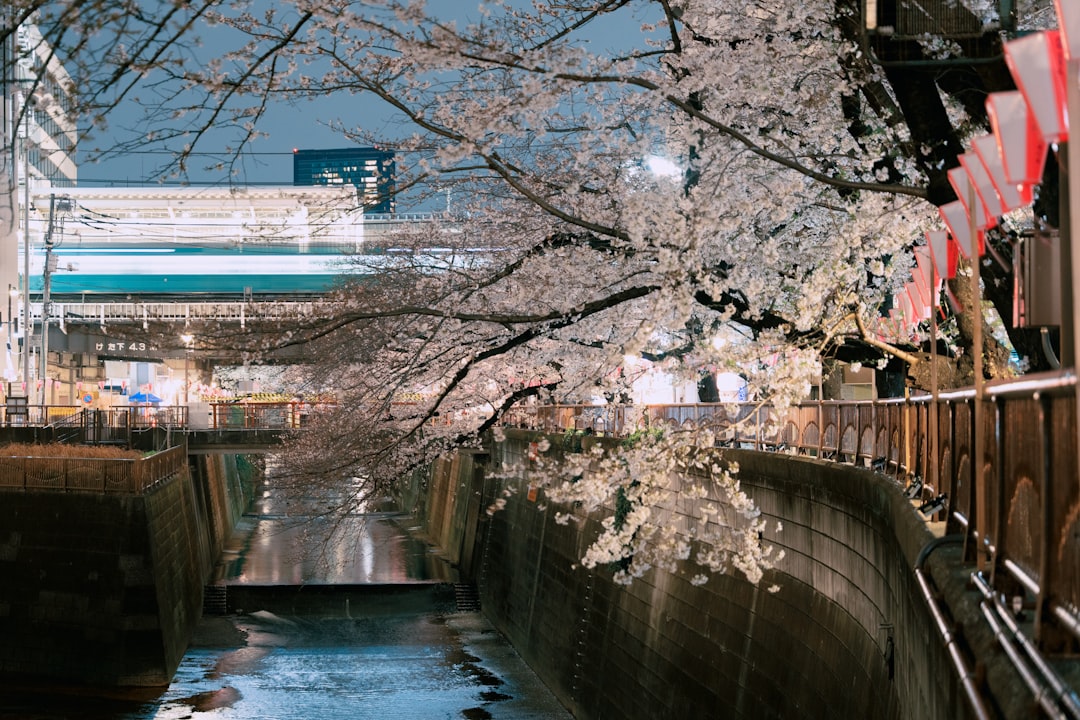
Cherry blossom (late March – early April): The obvious peak. Book accommodations 3–4 months ahead. Visit on weekday mornings before 8 AM for manageable crowds. Expect pink everywhere.
Autumn foliage (mid-November – early December): Criminally underrated for photography. The ginkgo trees turn a blinding yellow, the maples go deep crimson, and the canal reflection becomes a mosaic of warm color. Far fewer tourists. This is personally my favorite season to shoot here.
Winter (January – February): Bare branches, frost on the stone bridges, the lanterns feel extra warm against cold blue skies. The visual mood is moody and quiet — ideal for street portraits and atmospheric lone-figure shots.
Summer: Honestly, the least photogenic season. Dense green canopy blocks the light, humidity creates a slight haze, and the crowds are relentless. Skip it unless you’re specifically chasing a lush, jungle-city aesthetic. If you do find yourself in rainy conditions during other seasons, check out our guide to rainy day photography for creative alternatives.
Food, Coffee, and the Art of the Atmospheric Break
A good photo walk needs fuel, and Nakameguro’s café scene is exceptional — with a very practical bonus for photographers: the coffee cups and food here are beautiful and make for excellent detail shots between your canal compositions.
Small Axe Coffee, tucked just back from the south bank, serves a single-origin pour-over in a matte ceramic cup that photographs brilliantly. Order the hojicha latte in autumn — its roasted-caramel color against the ceramic and a bokeh canal background is genuinely its own Instagram moment. Around the corner, Onibus Coffee’s riverside terrace is the spot for people-watching and street candids while you rest your legs.
Just before dusk on my last November visit, I was sitting on a low wall near Nakameguro’s Tengenji Bridge with a paper cup of hojicha warming both hands, when a group of three elderly Japanese women in matching plum-colored coats stopped on the bridge above me to photograph the canal — one of them kept directing the others with serious, gentle authority, pointing at angles, adjusting their position, and I realized I was watching someone who understood composition deeply, completely absorbed in the same light I was chasing. She glanced down, caught me watching, and gave a single nod that felt like professional recognition between strangers.
Practical Logistics for the Photographer’s Day
- Getting there: Nakameguro Station on the Tokyu Toyoko and Tokyo Metro Hibiya lines. Exit the station and walk two minutes toward the river.
- Best route: Walk the canal from Nakameguro Station westward toward Daikanyama — this direction keeps the best light behind you in the afternoon.
- SD cards and batteries: Bring extras. Cold winter air drains batteries fast, and you will shoot more frames than you expect.
- Editing note: The canal’s artificial lantern light renders very orange on auto white balance. Shoot RAW and pull the temperature back to around 4500K for a truer representation of the blue-hour magic.
Nakameguro is not a hidden gem — it never was, and pretending otherwise would be dishonest. But there is a version of it that belongs entirely to the patient photographer willing to arrive before the crowd, wait for the right light, and look slightly left or right of where everyone else is pointing their lens. That version is worth every early alarm and every cold-fingered minute of waiting. If you’re seeking more waterside photography experiences, consider exploring Chuo Ward’s canal boat tours for different perspectives on Tokyo’s water routes. Go find it.