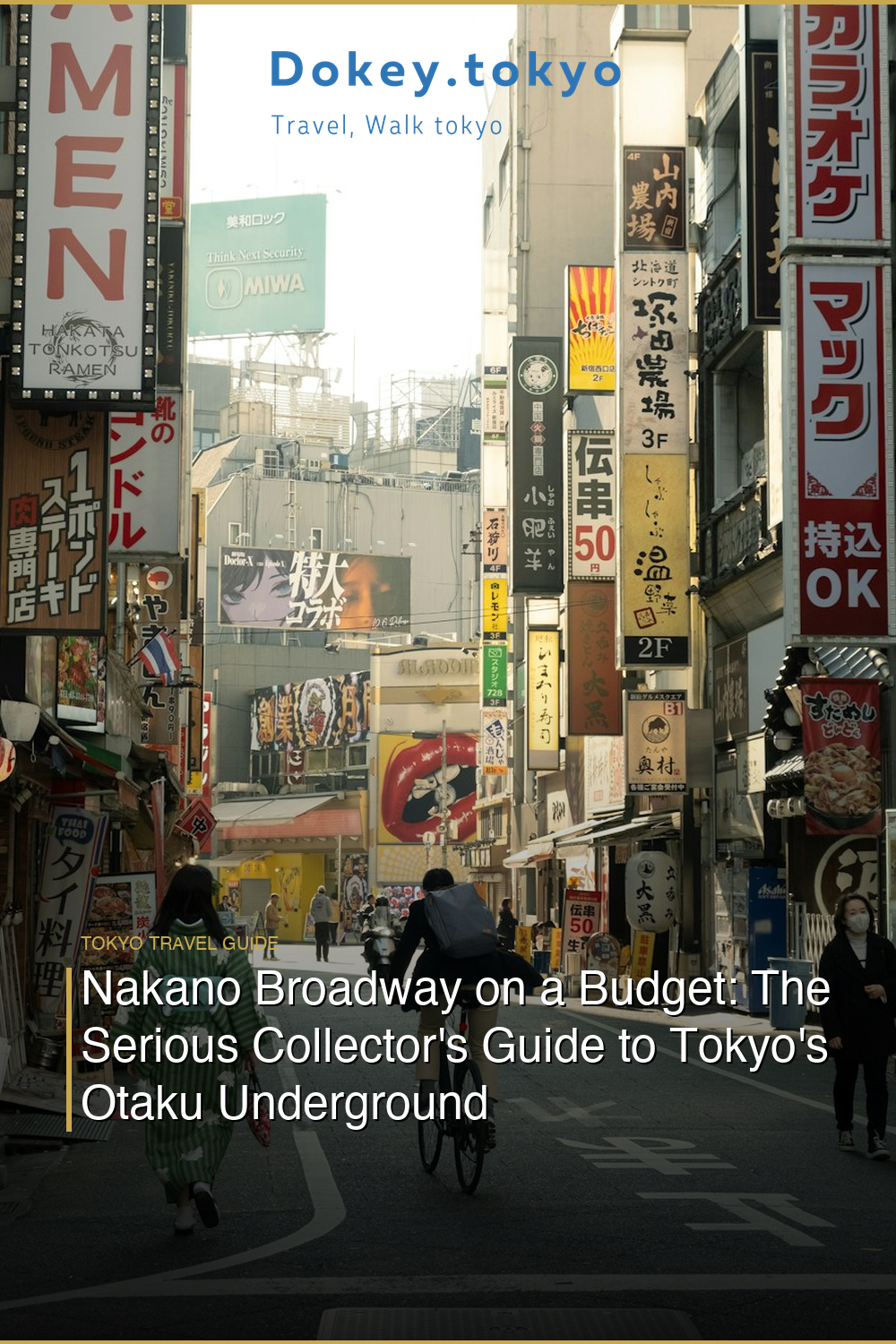
If you’ve already done Akihabara and you’re standing there thinking, there has to be more — trust me, there is. Nakano Broadway is where the real collectors go. It’s not as flashy, not as loud, and absolutely not as tourist-friendly, which is precisely what makes it extraordinary. Tucked behind a covered shotengai (shopping arcade) in the residential Nakano neighborhood, this four-story mall is a labyrinth of over 300 tiny specialty shops selling vintage anime figures, first-edition manga, retro game cartridges, idol merchandise, rare tokusatsu memorabilia, and things you genuinely cannot name but will absolutely need to own. Prices here skew lower than Akihabara because the foot traffic is lower and the sellers know their customer base is serious, patient, and comparison-shopping obsessed — exactly the kind of collector energy you need to bring through that door.
I remember stepping off the Chuo Line at Nakano Station on a grey Tuesday morning in November, following the covered arcade past a fruit stall and a 100-yen shop, and then suddenly smelling it — that particular blend of old paper, plastic packaging, and faintly dusty air conditioning that every secondhand bookshop in Japan seems to share. The fluorescent lights flickered slightly on the ground floor, and before I’d even reached the escalator, I spotted a glass case full of 1980s Gundam model kits with price tags that made my hands shake a little. I knew immediately I was somewhere that required a strategy, not a stroll.
Why Nakano Broadway Beats Akihabara for Budget Collectors
🗾 Book: Akihabara Anime Manga Walking Tour Hidde →
Akihabara is spectacular, but it’s optimized for retail therapy, not serious hunting. Nakano Broadway operates on a different frequency. The shops here are overwhelmingly secondhand specialists, and the pricing reflects condition grades that actual collectors care about — S-rank, A-rank, junk bin. You’ll find items marked down because the box has a crease, which means nothing to your display shelf and everything to your wallet.
The building itself is organized loosely across four floors, with Mandarake — the legendary secondhand otaku chain — occupying multiple separate storefronts throughout the complex, each one specializing in a different category. There’s a Mandarake specifically for garage kits, one for vintage shojo manga, one for tokusatsu props, one for doujinshi, and several more. Between the Mandarake branches, independent shops fill every corridor with their own obsessive niches. Budget around ¥5,000–¥15,000 (roughly $35–$100 USD) for a serious shopping session, though disciplined collectors have walked out satisfied on ¥2,000 if they hit the right junk bins at the right moment.
Floor-by-Floor: What to Look for and Where
🗾 Book: Anime and Manga Culture Private Tour →
🎫 Book: Tokyo Otaku Culture Walking Tours →
🎫 Book: Anime & Manga Museum Experiences →
🎫 Book: Akihabara District Shopping Tours →
Ground Floor and Arcade Approach
The ground floor is more everyday retail — a supermarket, a bakery, some clothing shops. Don’t skip the bakery if you arrive hungry; grab an anpan or a cream bun to fuel the hunt. The real magic starts when you take the escalators up. But do pause on the ground floor to check the Mandarake grand storefront entrance, which sometimes has display cases featuring newly acquired rare items right at the entrance. These rotate regularly and I’ve spotted sealed 1990s Dragon Ball Z figures here priced below market because they’d just come in from an estate lot.
Second and Third Floors: The Collector’s Core
This is where you spend most of your time and most of your money. The second and third floors are dense with specialty shops arranged in narrow corridors that feel genuinely maze-like. Navigation tip: pick a side wall and follow it around the perimeter first, then work the interior stalls. Otherwise you’ll double back and miss things.
For manga collectors, look specifically for the Mandarake branch that handles vintage shojo and josei titles — the staff here actually know their inventory, and if you show genuine interest and some basic Japanese (even just knowing the title and author name), they will sometimes bring out uncatalogued stock from the back. On my third visit, a staff member in a faded Sailor Moon hoodie overheard me asking about a specific Ryoko Ikeda title and quietly walked me to a box that hadn’t been priced yet, letting me dig through it first. That kind of interaction doesn’t happen in Akihabara’s tourist-facing megastores.
For figure collectors on a budget, the junk bins are non-negotiable. These are flat plastic trays or cardboard boxes filled with loose figures — no boxes, sometimes missing accessories — priced at ¥100 to ¥500 each. The finds are inconsistent, but the ratio of effort to reward is higher here than almost anywhere in Tokyo. I’ve pulled a mint-condition Nendoroid faceplate, a complete Evangelion gashapon set, and a hand-painted garage kit figure out of junk bins across multiple visits.
Fourth Floor: The Rarities and Memorabilia Zone
The fourth floor is quieter, less trafficked, and home to some of the more specialized dealers — vintage tokusatsu props, antique kamishibai picture cards, pre-Showa era illustration postcards, and shops dealing in items so niche they resist categorization. If you’re a collector with a specific obsession (vintage Ultraman merchandise, original Osamu Tezuka magazine publications, retro mecha model kits), this floor is worth an hour of patient browsing. Prices here are higher because the items are genuinely rarer, but negotiation is slightly more culturally acceptable in these tiny independent stalls than in the corporate Mandarake branches — approach politely, never aggressively.
Practical Tips for Budget Collector Shopping
Timing Your Visit Right
Weekday mornings are ideal. The building opens around 10am and the serious competition from other collectors is lowest before noon on Tuesdays through Thursdays. Weekend afternoons are crowded with locals and increasingly, tourists from Akihabara overflow, which means junk bins get picked over fast and staff are too busy to have those useful quiet conversations.
Mandarake restocks its floor inventory most visibly on weekday mornings, so arriving early gives you genuine first access. Follow @mandarake on social media — they post images of significant newly acquired items sometimes before they hit the floor.
Budgeting and Payment
Most shops in Nakano Broadway accept IC cards (Suica, Pasmo) and major credit cards now, but a handful of the tiny independent stalls are still cash only. Bring ¥10,000–¥20,000 in cash as backup. The nearest ATMs that reliably accept foreign cards are the 7-Eleven on the main Nakano shopping street, about a three-minute walk from the Broadway entrance.
For serious budget discipline, set category limits before you enter: ¥3,000 for manga, ¥5,000 for figures, ¥2,000 for miscellaneous. The environment is specifically designed to erode your financial decision-making capacity. Speaking from experience.
Shipping Your Haul Home
This is where budget collectors save or lose the game. If you’re buying volume, use Yamato Transport’s takkyubin service to ship boxes directly to your accommodation or to the airport. Packing materials are available at the Lawson inside the Broadway complex. Shipping a medium box domestically to a Tokyo hotel costs around ¥1,000–¥1,500. For international shipping, use Japan Post’s SAL or EMS services from a nearby post office — SAL is the budget option, significantly cheaper than EMS but slower.
Food and Breaks: Staying Energized Without Blowing Your Budget
🗾 Book: Anime Manga Tour with Ramen Lunch →
The shotengai leading to Broadway has several affordable lunch options. Nakano has a genuine local neighborhood feel, so you’re eating at prices aimed at residents, not tourists. There’s a tonkatsu set lunch at a tiny restaurant on the left side of the arcade that runs ¥800–¥1,000 for a full meal with rice, miso, and pickles. The McDonald’s inside the Broadway is the nuclear budget option at around ¥500 for a set. For coffee, there’s a Doutor nearby on the main street — ¥220 for a decent blended coffee, which you drink standing up like a local.
At around 3pm on my last visit, I bought a hot canned coffee from a vending machine on the third floor for ¥130, sat on a narrow bench outside a garage kit shop, and watched a man in his sixties carefully compare two identical-looking vintage Macross figures with a jeweler’s loupe — holding each one under the fluorescent light at slightly different angles, utterly absorbed. Nobody rushed him. The shop owner read a manga behind the counter. Time moved differently up there, and I realized this building has its own quiet culture of serious, respectful obsession that felt nothing like shopping and everything like belonging.
Getting There and Getting the Most Out of Your Day
Nakano Broadway is a 5-minute walk from Nakano Station, served by the JR Chuo Line from Shinjuku (two stops, ¥170, about 4 minutes). From Akihabara, it’s a 25-minute direct train. Budget collectors should plan a full day here — four hours minimum, six if you’re thorough. Combine your visit with Nakano’s local shotengai for cheap soba or ramen at lunch, and you have a complete, affordable, deeply satisfying Tokyo collector’s day for well under ¥20,000 total including food and a moderate haul.
Nakano Broadway isn’t trying to impress you. It doesn’t have neon signs aimed at cameras or English-language tour group signage. It’s just there, floor after floor, waiting for the kind of collector who knows that the best finds never come easily — and that the hunt is half the point.